
Regional Computer Programming Competition Held at USD

On the day of the event, participants spent five hours solving 11 real-world, complex algorithmic problems. Each team was composed of three members who worked together on a single computer. In total, 10 teams competed at the Vermillion site with three of those being USD teams.
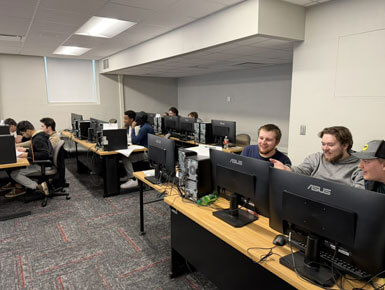
Zachary Tschetter, M.S., computer science instructor at USD, served as a site director for the competition. Along with Doug Goodman, Ph.D., associate professor of computer science, Tschetter coached the USD students who participated. Teams spent several weeks of practice working together to solve problems that require knowledge of data structures, algorithms, and programming techniques.
“My primary goals were to build students’ confidence with algorithmic problem-solving and to give them authentic practice working under timed, high-pressure conditions. We also tried to cultivate teamwork through weekly mock contests,” Tschetter said. “I felt these goals were met very well—the students showed noticeable growth in both their technical approach and their ability to stay calm and communicate effectively during the contest.”
With six correct answers, a team from Dordt University solved the most problems in the competition, ranking 21st out of an estimated 80 teams competing at the 15 sites throughout the region.
For USD student team members, participating in the competition reinforces the habits they learn in class, such as reading carefully, validating assumptions and building efficient solutions, Tschetter said.
“Beyond technical skills, students develop resilience, communication under pressure and the ability to break down ambiguous problems as a team,” he added. “They also gain confidence from competing against peers across the region, which reinforces their sense of belonging in the field. Also, participation in this event looks great on a resume, especially if they advance to the next round.”
KC Santosh, Ph.D., professor and chair of USD’s Department of Computer Science, said the department will host future International Collegiate Programming Contest events.
“Other than our signature annual AI symposium, we are proud to host events like ICPC, which showcase how we prepare our students beyond traditional coursework,” Santosh said. “These experiences reflect our strength as a powerhouse in AI and computing education, built on strong foundations in algorithms and system design. We will continue hosting this competition every other year to provide meaningful, hands-on learning opportunities for our students.”
You May Also Like

USD College of Fine Arts Announces New Piano & Music Technology Lab
The Department of Music at the University of South Dakota is unveiling a new named space this Oct. 9: The De & Dave Knudson Piano & Music Technology Lab.

Baack Named President of Sanford Research
Dr. Michelle Baack ’95, professor and chair of the University of South Dakota’s Sanford School of Medicine (SSOM) Department of Pediatrics and the Karl H. Wegner, M.D., chair in medicine, has been named president of Sanford Research.

USD Theater to Open Season Oct. 1 With ‘Stop Kiss’
The University of South Dakota’s Department of Theatre will present Diana Son’s “Stop Kiss” to open the 26-27 theater season, with performances Oct. 1-3 at 7:30 p.m. and a matinee performance on Oct. 4 at 2 p.m. in the Wayne S. Knutson Theatre.
