Campus Connections and Cross-Continent Collaboration

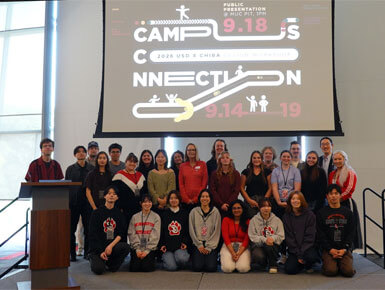
The workshop, titled “Campus Connections: Reimagining the Wayfinding Experience,” took place from Sept. 14 to 19 on the USD Vermillion campus, concluding with a public presentation of the student’s final projects. Eighteen graphic design students from USD and eight communication design students from Chiba University compared public signage systems in Japan and New York, analyzed their visual and cultural characteristics and proposed a new campus signage system for USD.
Young Ae Kim, Ph.D. ’22, M.A. ’17, a professor in USD’s Department of Art, first explored the possibility of a joint program her collaborator Ikjoon Chang, Ph.D., of Chiba University when he visited USD as a guest of the graphic design program in 2024. Chang currently serves as an associate professor within Chiba University’s Design Research Institute. Chiba University is a highly regarded national university in Japan with a strong history of research in engineering and design.
Kim said of Chang, “His design expertise and commitment to education made that initial visit especially valuable and laid the groundwork for a lasting relationship. Our partnership brings together the distinctive strengths of both institutions to advance international learning and creative exchange.”
The first USD x Chiba Design Workshop was launched in March 2025, followed by a second on USD’s campus in September of the same year. In May 2026, nine USD students visited Chiba University’s Sumida campus in Tokyo, Japan, for a reciprocal workshop. These nine students were generously supported by Chiba University, which covered their expenses during their 10-day stay.
“During the Tokyo workshop, USD and Chiba students worked together to develop brand identities and packaging designs for selected coffee shops participating in the Sumida Coffee Festival,” Kim said. “The project connected our academic collaboration with the local community, bringing together the Sumida City government, participating business owners and students from both universities. At a public presentation, student teams shared their proposals with city representatives and business owners and received direct feedback. This gave students valuable experience addressing real business needs, communicating their design decisions and exploring how cultural context shapes branding and visual communication.”
In August 2026, the exchange program transitioned from a faculty-led initiative to a formal institutional partnership. A university-level agreement is valuable as it opens the door to broader opportunities across multiple disciplines for students and faculty of both universities.
During this year’s workshop, students formed four groups assigned to one major USD campus location. USD and Chiba students were joined in teams so their different cultural backgrounds, experiences and design approaches could become resources for investigation and creativity.
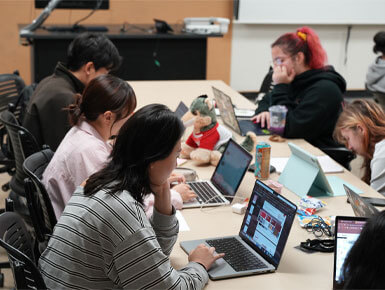
Each student group developed proposals for improving the wayfinding experience of their assigned locations by examining how people process information while navigating. They focused on six stages: arriving, orienting, choosing a direction, confirming they are on the right path, recovering when confused, and recognizing their destination.
Kim shared, “The students began by visiting their assigned locations and documenting entrances, directional signs, room identification, overhead signage, floor graphics, accessibility information, visual landmarks and areas where users might become uncertain. They photographed existing conditions, analyzed sign placement, studied circulation patterns and considered the relationship between each building’s identity and its navigational system.”
This workshop’s uniqueness arises from the combination of an intensive schedule and cross-cultural collaboration. Within a few days, students built working relationships, communicated across language differences and established a shared design direction. Students also brought different interpretations to the same challenge, encouraging them to question familiar assumptions and discover possibilities they may have overlooked individually.
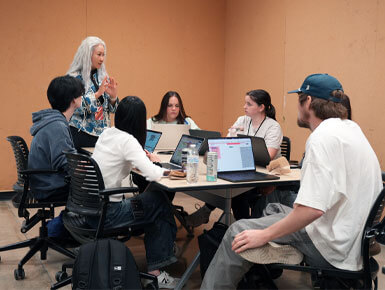
“I am particularly proud of how students brought their different cultural perspectives and experiences into a shared creative process,” Kim said. “They listened to one another, questioned familiar assumptions and developed ideas together. During the campus wayfinding workshop, seeing USD students reconsider familiar spaces through their Chiba teammates’ observations was especially meaningful. That exchange encouraged them to recognize how differently people experience the same environment and explore how design can help people feel oriented, confident and welcome. I want students to understand that listening, observing, documenting experiences and questioning cultural assumptions help them identify meaningful problems and discover possibilities they might otherwise overlook.
“These experiences are especially valuable in graphic design, a practice-based discipline where students learn by doing,” Kim continued. “As they research, develop concepts, collaborate and present their work, they also learn to manage deadlines, communicate across differences and take responsibility for shared outcomes. These are professional habits they will need in a company or design studio. The partnership gives them opportunities to build those skills before graduation and prepares them to contribute with greater confidence, cultural awareness and a sense of responsibility to the communities they serve.”
The next USD x Chiba University Workshop is scheduled for September 2027 in Vermillion. Kim thanked her co-lead Chang “for his expertise and sustained commitment and Chiba University for its collaboration and generous support of our students.” She also thanked those who attended the final public presentation. Those present included President Sheila K. Gestring and Provost Kurt Hackemer, demonstrating an institution-wide interest in students’ work and international collaboration.
You May Also Like

USD Researchers Collaborate on $1.06 Million AmeriCorps-Funded Youth Civic Engagement Project
A team of researchers from the University of South Dakota, the University of Minnesota and Iowa State University have been awarded a three-year, $1.06 million grant to strengthen youth civic research and engagement in the region.

USD Strengthens Its Commitment to Sioux Falls With New Director of Community Relations
As the University of South Dakota continues to see Sioux Falls as an essential part of its future, strengthening its connection to the community has been central to its vision.

UPD Sergeant Amanda Sandbulte Recognized as VFW Law Enforcement Officer of the Year
On Saturday, Nov. 14, Sergeant Amanda Sandbulte was recognized as the VFW Law Enforcement Officer of the Year during the University of South Dakota Coyote Football Veterans and First Responders Game.
