
The Physician Who Never Stopped Learning

This story was written by Areej Nazir, SSOM Class of 2029.
Born in San Antonio, Texas, with a father in the U.S. Army, he spent his early years bouncing between Alabama, Georgia, South Korea and West Germany before eventually landing in Brookings, South Dakota. Much like the roots he never quite put down, his path into medicine was anything but linear.
In high school, he says, he was mostly bored with the subjects and did not study or do any homework. “How I graduated, I have no idea,” he comments with the soft, wry smile his students know so well.
It wasn’t until college that he began to appreciate the fun of learning.
He started college as a history major with plans to teach high school. When he was informed he might need to coach to find work, he switched into biology and chemistry and eventually wound up in a research lab. While this was partly due to an underlying passion for the natural sciences, realistically, it was mostly because he needed to pay tuition.
Eventually, inspired by a blossoming love of learning and research, Dvoracek began a Ph.D. program in experimental pathology at the University of Michigan. However, his aspirations to become a research scientist changed when he realized the career he was pursuing didn’t quite match what he actually enjoyed.
“All the professors spent their time managing a laboratory,” he shares, “and it didn’t look as fun as the hands-on experiences I had as an undergraduate.”
So he took the MCAT and applied to medical school. Stumbling into the field that would shape his career, he shifted course once again.
Dvoracek returned to South Dakota to attend the USD Sanford School of Medicine, graduating in 1996, and then completed a residency in anatomic and clinical pathology and a fellowship in surgical pathology. He was drawn to the field’s emphasis on problem-solving, although he was candid about his limits.
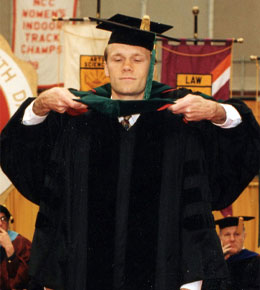
“I loved the basic science years and problem-solving but had a hard time following up day after day. Once the diagnosis was known, my interest flagged,” he shrugs with a smile. “I guess I have a short attention span.”
Pathology, with its focus on patterns and diagnosis, turned out to be the right fit. With the specialty’s alignment with the pure, scientific nature of his Ph.D. background, and the general happiness he witnessed among who would become his future colleagues, Dvoracek completed his residency at University of Iowa and then spent the next 17 years of his career as a pathologist in St. Cloud, Minnesota.
As the years passed, however, even practicing pathology began to feel routine. He found himself burned out and considering early retirement when he overheard a colleague mention an opening for a pathology professor position at the Sanford School of Medicine. For the lifetime learner, the answer seemed obvious. Within a week, he had applied.
“Teaching and being around people who are excited about life made medicine fun again,” he says. “Medical school is intense, but we should pause and remember how amazing our subject matter—the human being—is.”
It’s a sense of wonder he’s carried since his early days in pathology: the realization that symptoms, histology and the way the body behaves follows repeatable patterns across every human being. This curiosity is reflected in lectures that draw on pop culture as readily as in a textbook.
“A knowledge of medicine will give you insights into so many references in literature, architecture, history, grocery store conversations and even ‘70s hair metal bands,” he explains. “It is fun to notice those things, and to pass them along to students. I like to put those things into lectures because it helps break up a long day. I think it must be challenging to have such long lecture schedules so a little Alan Jackson might help.”
He pauses for a moment, then adds, “Plus, it is a crying shame that the younger generation has never heard of Linda Ronstadt.”
Staying curious, he knows, is harder than it sounds.
Medicine’s culture of relentless achievement and high-stakes examinations has a way of crowding out that sense of wonder. With the increasing emphasis on USMLE STEP 1 and STEP 2 testing, Dvoracek wonders if the constant pressure to “teach the test” has distorted the joy that he believes accompanies the pursuit of medical knowledge.
“It’s like telling English majors they should focus on memorizing Cliff Notes when what they really need is to have some tea and enjoy the book,” he says. “I know this is a bit utopian, but I hope our teaching style and pressure don’t take the joy out of learning.”
Another barrier he notices is the quiet reshaping of how students understand their own worth. Instead of focusing on accomplishment and test scores, he offers a grounding reminder: Your value and identity are already given to you and cannot be earned.
That security, he believes, is what makes a better physician.
“Part of being an excellent physician is to be able to make human connections,” he reminds us. “So, remember to make time to have hobbies, hang out with friends and be outside.”
It’s advice that comes from experience, not theory.
For someone whose path into medicine was anything but straightforward, Dvoracek’s students may argue his greatest lessons have little to do with pathology. Instead, his compassion, connection and sense of humor are what make the histology slides stick for STEP 1. He’s a doctor who found his way back to medicine through teaching and, in doing so, reminds his students not to lose what drew them to it in the first place.
You May Also Like

Avera, SDSU and USD Sanford School of Medicine Establish Statewide NIH Research Partnership
The National Institutes of Health awarded $11,090,204 over five years to establish the South Dakota Center for Advancing Clinical and Translational Research (SD-ACT), a statewide partnership among Avera Research Institute, South Dakota State University and the University of South Dakota Sanford School of Medicine.

USD Philosopher Joseph Tinguely Awarded John Templeton Foundation Grant
Joseph Tinguely, Ph.D., was recently awarded a grant from the John Templeton Foundation in the amount of $435,790. This grant will support him as he organizes interdisciplinary collaborators with the aim of producing a conference, an edited manuscript and a series of public-facing media.

Educators Rising Day Welcomes Future Educators, Inspires Next Generation
The University of South Dakota welcomed approximately 150 high school students from 12 schools across South Dakota and Nebraska on Sept. 23 for Educators Rising Day, an event designed to introduce students to careers in education and help them explore their future as teachers, leaders and advocates.
