
USD University Libraries Receives Grants from the National Endowment for the Humanities

USD first received a sub-award on a $750,000 Rediscovering Our Revolutionary Tradition grant to Mississippi State University, supporting the work of the Civil War and Reconstruction Governors of Mississippi digital scholarly edition, a partnership between MSU and USD.
The project consists of preserving, transcribing, annotating and publishing 20,000 letters, telegrams, petitions and other records sent to Mississippi governors from 1859-1882. The grant will support the publication of more than 2,400 additional documents, the annotation of 9,000 people found within the collection and expanded educational outreach. At USD specifically, the grant will fund graduate student training, editorial work, curriculum testing and publication, and educator institutes that will prepare teachers to use these primary sources in history, civics and government classrooms.
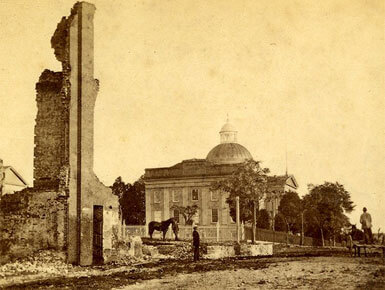
This 'Secession' image is from the Mississippi Department of Archives and History.
The second is a $350,000 grant to USD supporting the work of the Dakota Territory Papers Project scholarly edition, a project founded at USD in partnership with the North Dakota State Historical Society, South Dakota State Historical Society and Center for Western Studies.
As another digital scholarly edition, this project seeks to preserve and digitize Dakota Territory records from 1861-1889 in the Digital Library of South Dakota, while creating the foundation for a comprehensive digital edition that will illuminate the histories of national Reconstruction, westward expansion and the creation of North and South Dakota. USD is leading this project, and the team will digitize more than 27 linear feet of gubernatorial papers and 140 legislative records in the USD Digital Imaging Lab, create descriptive metadata and searchable transcriptions, and publish these materials in regional digital libraries and develop open access educational resources for K-12 classrooms.
This project will also pilot innovative digital workflows that combine artificial intelligence with expert human review in FromThePage with project partners Sara and Ben Brumfield at Brumfield labs. USD students and faculty will provide human review of the AI-generated metadata, as well as the digital infrastructure and process.
According to Lindsey R. Peterson, Ph.D., digital humanities assistant professor of practice, both projects examine how Americans interpreted and debated the principles of citizenship, constitutional rights and government during periods of profound change—the Civil War, national Reconstruction and westward expansion.
“Together these grants support nationally significant projects that preserve, digitize and make accessible historical records that have been difficult for scholars, educators and the public to access and use,” said Peterson. “The grants also recognize the importance of expanding our understanding of American democracy beyond the nation’s founding. By making these records freely available online with searchable transcriptions, annotations and educational resources, we’re ensuring historical voices are accessible to everyone, regardless of where they live.”
Because of these initiatives, historical records that have traditionally required research trips or specialized archival expertise will be made available. Scholars and the general public will gain access to searchable collections that support new research on democracy, citizenship, American wars, national Reconstruction, western history, state formation and beyond.
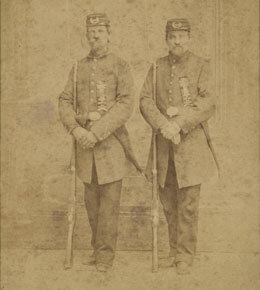
Ed Dimmick and Henry Butler holding rifles in military style uniforms displaying Grand Army of the Republic (GAR) membership ribbons on their uniforms and GAR insignias on their caps. Credit belongs to the USD University Libraries Archives and Special Collections.
Receiving these two nationally competitive NEH awards—of which only 33 of 103 applicants were awarded—demonstrates USD’s emerging role as a recognized leader in scholarly editing. The projects also position the university as a center for rigorous, collaborative scholarship, where historical research, digital technologies, public engagement and student training intersect.
“The University of South Dakota is grateful to the National Endowment for the Humanities for the awards that are essential to advancing the scholarly editing projects, both of which are at the foundation of the university’s nascent digital humanities and scholarly editing program that is capably led by Dr. Peterson,” stated Dan Daily, dean of libraries. “Dr. Peterson joined the faculty of the University Libraries in 2023 and has dedicated herself to rapidly developing a program that is making an impact at the university and beyond.”
You May Also Like

USD College of Arts & Sciences to Host 2026 Pillars of Distinction Awards Night and Hall of Fame
The University of South Dakota College of Arts & Sciences will host the second annual Pillars of Distinction Awards Night and Hall of Fame on Friday, Nov. 13, 2026, from 6 to 9 p.m. in the Muenster University Center Ballroom on the USD campus in Vermillion, South Dakota.

Legal Learning: South Dakota Supreme Court Convenes at USD
The South Dakota Supreme Court travels through the state twice a year to hear oral arguments at public institutions, giving the public an opportunity to observe the court in action. Each year, the court holds one of their sessions at the University of South Dakota Knudson School of Law.

USD Professor Tom Mrozla Wins National Teaching and Mentorship Award
Thomas Mrozla, Ph.D., associate professor of criminal justice and the criminal justice program coordinator at the University of South Dakota, has been honored with the American Society of Criminology Division of Policing Teaching and Mentorship Award.
