
Physics Researchers at USD Successfully Fabricate High-Performance Germanium Detector

The detector was developed using a high-purity germanium (HPGe) crystal grown entirely on the USD campus, highlighting the university’s growing leadership in the end-to-end production of cutting-edge physics materials.
High-purity germanium crystals are critical for the production of advanced radiation detectors, which are essential for key scientific experiments, including the search for dark matter and the study of neutrino properties. With the global supply of detector-grade germanium crystals being limited, USD’s work in this space has helped to address a bottleneck for large-scale underground experiments and achieve critical advancements in improving the efficiency of germanium crystal production.
The new detector features an innovative hybrid contact design, utilizing lithium diffusion to create the n+ contact and an amorphous germanium layer for the p+ contact. This complex fabrication process ensures exceptional charge collection and minimal signal loss, which is essential for the demanding conditions of modern nuclear and particle physics experiments.
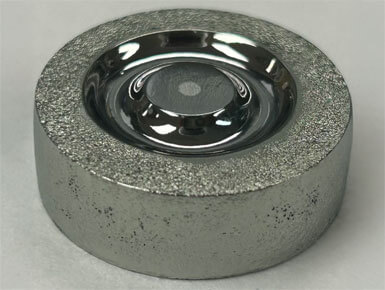
During rigorous laboratory testing, the USD team demonstrated that the detector can be fully depleted at just 200 Volts and operates flawlessly at 700 Volts.
The performance metrics of the new ICPC detector are striking. When tested using a Cesium-137 (137Cs) radiation source, the detector achieved a Full Width at Half Maximum (FWHM) of 1.71 keV, alongside an ultra-low electronic noise level of just 1.34 keV.
Most notably, the device exhibits an outstanding statistical energy resolution of 0.16%. Achieving this level of precision is a critical requirement for next-generation physics research, such as the search for dark matter or neutrinoless double-beta decay, where isolating incredibly faint, rare energy signals from background noise is paramount.
This successful fabrication not only proves the viability of USD-grown germanium crystals but also establishes a reliable, reproducible method for creating ICPC geometries with amorphous and lithium-diffused contacts. The achievement is a significant step forward for the Ge-STAR project and paves the way for scalable, high-yield production of detector-grade materials right in South Dakota.
For more information about the physics research at USD, please visit the Department of Physics website.
You May Also Like

USD’s Master of Public Health Program Achieves Reaccreditation
The University of South Dakota and South Dakota State University’s joint Master of Public Health (MPH) program has been granted reaccreditation for a seven-year term, the maximum given, by the Council on Education for Public Health (CEPH).

SPURA Students Present at 2026 Eastern South Dakota Undergraduate Research Symposium
Eight undergraduate researchers participating in the University of South Dakota’s Summer Program for Undergraduate Research in Addiction (SPURA) finished a productive summer of research by presenting their work at the 2026 Eastern South Dakota Undergraduate Research Symposium.

USD Knudson School of Law Alumni Honored With 2026 Unleash Your Legacy Awards
Two distinguished alumni of the University of South Dakota Knudson School of Law were recognized as recipients of the 2026 Unleash Your Legacy Alumni Achievement Awards, celebrating their exceptional professional accomplishments, leadership and commitment to serving others.
