
USD Students Support Athletes at the South Dakota Special Olympics Summer Games

Grace Stansbury, Taylor Schallenkamp and Megan Linke helped conduct hearing screenings for 85 athletes as part of the Special Olympics Healthy Athletes program, which offers free health evaluations and education to participants.
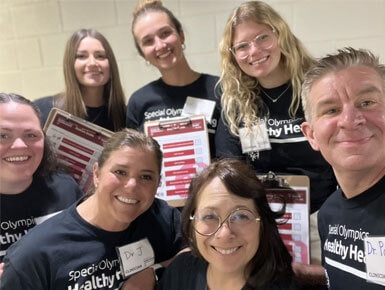
Throughout the event, USD students guided athletes through a series of hearing tests, including an otoscopy, otoacoustic emissions, tympanometry and pure-tone screening. They also explained the process step-by-step to athletes and their families, creating a comfortable and supportive environment for everyone.
“I enjoyed interacting with the athletes and getting to know more about them, like which events they were excited for,” said Stansbury. “It taught me a lot about how I can interact with current and future patients to ensure that I supply them with compassionate care and make them feel seen.”
Stansbury, along with Schallenkamp and Linke, also utilized visual schedules developed by Elizabeth Hanson, Ph.D., associate professor in the USD Department of Communication Sciences & Disorders, and Marni Johnson, Au.D., associate professor of pediatrics in the USD Sanford School of Medicine, to help athletes understand the screening process and navigate through several steps during the exams.
“The visual schedules show every client what’s going to be done when going through each station,” said Schallenkamp. “It uses a picture to help athletes understand what’s going to be done, which calms their nerves and reduces anxiety levels throughout the day. The athletes can also mark off every station and move to the next with ease.”
The schedules have proven so effective that the Special Olympics International recently adopted them for use in Healthy Athletes programs around the world, making them available as an optional, downloadable resource for those running the Healthy Athlete services wherever they’re offered.
“I love that the Special Olympics International adopted the visual schedules,” said Stansbury. “It allows athletes to fully understand what’s happening and what screenings they will complete without feeling blindsided. For those who are visual learners, offering additional resources is very accommodating.”
An Unforgettable Experience
For each of the three students, the experience provided valuable hands-on learning opportunities.
One interaction that stood out to Stansbury involved an athlete who was deaf and used American Sign Language to communicate. Stansbury, who took ASL classes in high school, took note of this and adjusted her screening routine, incorporating sign language throughout the appointment to enhance communication with the athlete and their father.
“I realized that sometimes I may need to change my routine and alter my screening process to ensure I make the environment suitable for all athletes,” Stansbury said. “It was just one example of how clinicians alter their practices to best fit the needs of the patients.”
Schallenkamp recalled working with a blind athlete, an experience that challenged her to rely less on visual resources and more on verbal expressions.
“Learning how to talk this athlete through the many different steps without a visual aid was challenging but impactful,” Schallenkamp said. “It made me think of ways I can adapt my communication strategies instead of leaning on visual materials for screenings.”
Overall, their experience and time at USD have prepared them to work with various populations and emphasized the importance of individualized care.
“Some patients may be comfortable with screenings, while others may show anxiety. Volunteering at the Special Olympics Summer Games, along with my USD education, has prepared me to recognize each patient’s needs and adapt my approach,” said Schallenkamp. “The experience will carry over to my professional life, while working in schools or hospitals with similar clients, who may struggle with screenings.”
Stansbury said that representing USD at the Special Olympics Summer Games was especially meaningful.
“USD is committed to its students and the services they provide through their degrees. Participating in this event is something I am very proud of, as it’s rewarding to know we are making a positive impact on the individuals we serve,” said Stansbury. “It motivates me to grow into a compassionate advocate for my future patients and families, and to speak up when I believe something will benefit my patients and ensure they get the best care possible.”
You May Also Like

South Dakota Launches ‘Rural Health Forward’ to Strengthen Rural Healthcare Workforce
South Dakota has launched Rural Health Forward, a new statewide initiative to strengthen rural healthcare workforce training and support. This initiative is funded through the federal Rural Health Transformation Program (RHTP) grant that supports expanded access to high-quality healthcare in rural areas statewide.

USD President Sheila K. Gestring Announces Retirement
After nine years leading the University of South Dakota, President Sheila K. Gestring has announced her retirement, effective June 21, 2027.

Avera, SDSU and USD Sanford School of Medicine Establish Statewide NIH Research Partnership
The National Institutes of Health awarded $11,090,204 over five years to establish the South Dakota Center for Advancing Clinical and Translational Research (SD-ACT), a statewide partnership among Avera Research Institute, South Dakota State University and the University of South Dakota Sanford School of Medicine.
