
USD’s Archaeology Laboratory Unveils New Digs that Enhance Hands-on Experiences for Students

What once resided in the low-ceilinged, dark basement of the Vermillion campus’s East Hall now inhabits a large, sun-filled space on the building’s first floor.
The USD Archaeology Laboratory, often referred to as ARCHLAB, occupies four rooms along a hallway and consists of 3,156 square feet of space dedicated to archaeology and forensic anthropology. USD has housed archaeological artifacts and lab facilities since the 1970s. The lab’s collections include artifacts from more than 200 sites.
At the early February ribbon cutting for the new facility, USD President Sheila K. Gestring spoke about the experiential learning students receive at the ARCHLAB. “Hands-on learning is critically important and at the heart of a USD education,” she said. “This updated lab strengthens the real-world experiences gained through research, mentorship and fieldwork.”
Anthony Krus, Ph.D., associate professor and chair of the Department of Anthropology and Sociology, said the renovated facility will build on USD’s reputation as a leader in Great Plains archaeology.
“The Department of Anthropology and Sociology is proud of what we were able to accomplish with that previous basement ARCHLAB space. Our archaeology alumni have gone on to achieve a number of professional positions including numerous state archaeologists, professors and pioneers in the archaeology of the Great Plains. This renovated space is an enormous upgrade from that previous ARCHLAB space, and I’m so excited to see what the future holds for this lab.”
The new ARCHLAB consists of a large classroom and storage facility, a room containing the lab’s collection of bones (both animal bones and synthetic replicas), a small library and another large room for cleaning, identifying and cataloging artifacts. This room also includes a water source and tools needed to perform water-based processing of small artifacts and botanical samples.
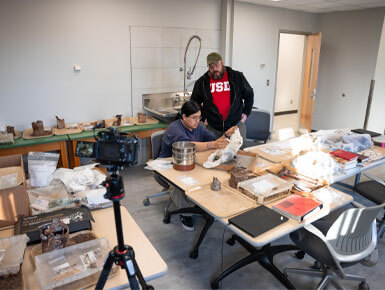
The ARCHLAB is regularly used by undergraduate students who focus their studies on archaeology, department faculty members and resident archaeologists who perform field research and mentor students.
Even before the ribbon cutting event, undergraduate students have been making good use of the new facilities. A group of students have been meeting three times a week to clean and identify artifacts found at the program’s annual Susan Tuve Archaeology Field School held near Sturgis, South Dakota. The field school’s dig site, on what is called Soapsuds Row on the Bear Butte Creek Historic Preserve, includes an area with houses for the women who washed laundry for soldiers at Fort Meade, a major military outpost in the late 1800s and early 1900s.
“We are all pretty passionate about archaeology,” said group member Greyson Baumberger, a sophomore from Lead, South Dakota.
In the new ARCHLAB, Baumberger carefully cleans with soft brushes and special picks the items found over the past few years in the one-by-one-meter-square plots at the Soapsuds Row excavation site. Doing this work in the controlled lab setting allows for more careful curation of the found items, he said.
“We found a lot of cans that you wouldn’t want to clean in the field because the inside might contain other artifacts like seeds or bone or wood,” he said.
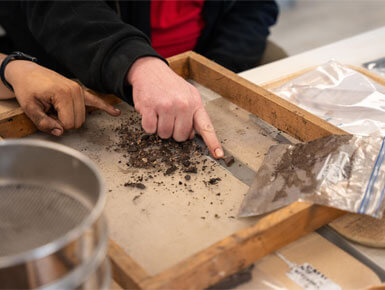
Natalie Wagner, a junior anthropology major from Chatham, Illinois, is another member of the morning ARCHLAB group. She attended the archaeological field school at Soapsuds Row in 2024 and credits the summer experience for strengthening her already deep interest in archaeology.
“Working in the field was honestly the coolest thing I’ve ever done,” Wagner said. “It’s amazing how much detail and effort goes into everything. You have to record everything, make sure your lines and units are correct and everything is mapped out. It is so cool to see how much effort goes into finding and recording artifacts.”
She is just as enthusiastic about her work back at USD in the ARCHLAB. “It’s kind of a meditative process,” Wagner said. “You really get into cleaning and then researching and identifying the artifacts.”
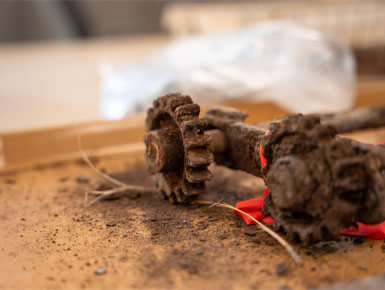
Aaron Meyer, a 2014 graduate of USD’s anthropology program, is an archaeologist in residence at USD who performs his own research in the ARCHLAB but also assists undergraduate students with their research. He is currently working with students on analyzing the plant remains from Soapsuds Row using a screening technique in the wet lab and sorting and identifying them under a low-powered microscope.
Meyer said the new lab will secure USD’s leading role in educating archaeologists in the region.
“USD is the only public university or college in South Dakota that produces archaeologists. It is very important we keep doing so to educate and find them occupations that are much needed in the region,” he said. “This new space will assist students for many years to come.”
Brian Molyneaux, Ph.D., is also a USD archaeologist in residence. He has been affiliated with the archaeology program for 35 years.
“I began in the old lab as a research archaeologist in 1991,” he said. “Yes, it was in the basement, stuffy, poorly lit under all the pipes and with odd tunnels nearby, but archaeologists always have to put up with challenging conditions in the field, so we made it work. Back in the day, the working conditions were part of the problem—now staff and students can concentrate on doing what they came to USD for.”
ARCHLAB work is crucial to student development, Molyneaux said.
“The experience they gain working with real-life dirt and debris helps them distinguish the actual past from how it is often presented,” he said. “They end up with a much more realistic view of the world they face every day, and it sharpens their ability to think critically over the rest of their lives.”
You May Also Like

Avera, SDSU and USD Sanford School of Medicine Establish Statewide NIH Research Partnership
The National Institutes of Health awarded $11,090,204 over five years to establish the South Dakota Center for Advancing Clinical and Translational Research (SD-ACT), a statewide partnership among Avera Research Institute, South Dakota State University and the University of South Dakota Sanford School of Medicine.

USD Philosopher Joseph Tinguely Awarded John Templeton Foundation Grant
Joseph Tinguely, Ph.D., was recently awarded a grant from the John Templeton Foundation in the amount of $435,790. This grant will support him as he organizes interdisciplinary collaborators with the aim of producing a conference, an edited manuscript and a series of public-facing media.

Educators Rising Day Welcomes Future Educators, Inspires Next Generation
The University of South Dakota welcomed approximately 150 high school students from 12 schools across South Dakota and Nebraska on Sept. 23 for Educators Rising Day, an event designed to introduce students to careers in education and help them explore their future as teachers, leaders and advocates.
