
Finding Purpose Through Music: Kari Edman’s Journey Into Music Therapy

Originally from Groton, South Dakota, Edman’s path into her current career began unexpectedly during her junior year of high school when a career aptitude test pointed her toward a profession she had never heard of before—music therapy.
“At the time, I had no idea what music therapy was,” Edman said. “But after doing a little research and taking a trip to Sioux Falls to observe a music therapist, it was hook, line and sinker. I knew it was a field where I could combine my passions and values to make a meaningful impact.”
Edman quickly turned that interest into reality and attended the University of South Dakota. In 2020, she graduated with a Bachelor of Musical Arts and an education composite minor. She continued her education through the Music Therapy Equivalency program at the University of Minnesota and became a board-certified music therapist in 2022.
Today, Edman works at LifeScape, where she spends most of her week at the Specialty School leading group music therapy sessions for students while also supporting adult day services, residential programs and patients in the specialty hospital.
There she teaches in the music room, seeing each class twice a week for 30-minute group therapy sessions, which are often filled with playing instruments, songwriting, singing and even dance parties. To an observer, it may look like fun, but each activity is intentionally designed to support non-musical goals.
“The easiest way to describe music therapy is using music to address non-musical goals,” Edman explained. “We work toward social, communication, cognitive and physical goals during sessions.”
Edman works with individuals of all ages, abilities and group sizes. Adaptability, she says, is one of the most important parts of the job, as a carefully planned session can quickly shift depending on the needs of the individuals in the room.
“Sometimes you need to meet the individual where they are in the moment. That might look like dropping the instruments and singing a cappella to create a calmer environment,” she said. “Other times, you might add an impromptu movement song to help burn off extra energy or switch to a favorite requested song.”
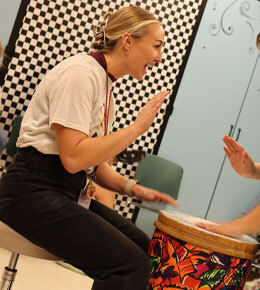
That flexibility reflects the qualities Edman believes are essential in a successful music therapist: patience, creativity, understanding and open-mindedness. She also notes that different populations or locations require different approaches—such as a music therapist practicing in a hospice setting versus a school setting—making the field both challenging and rewarding.
“One of the greatest rewards is witnessing the power of music day in and day out,” she said. “Music can bring joy, connection, comfort, care and community to everyone. I’m fortunate to be part of that every day.”
Edman also acknowledges that music therapy is a relatively unique profession—especially in a rural state—and can be viewed by others as entertainment rather than evidence-based clinical practice. Yet that perception has only strengthened her commitment to advocacy and education.
“When facing those challenges, I remind myself that music therapy is a clinical, evidence-based profession and that the work I’m doing is making a meaningful difference,” she said.
Reflecting on her journey, Edman credits her personal and professional growth to her time at USD and her involvement on campus as a Student Ambassador, a member of Chamber Singers, a participant in Greek Life and a dance instructor at the local studio Vermillion Area Dance Organization, which provided a space to “put herself out there” while challenging her creativity.
“Each of these opportunities allowed me to get involved throughout the campus and in the community,” she said. “They helped me build lasting relationships and grow as an individual.”
Edman also points to the influence of several faculty mentors, especially David Holdhusen, Ph.D., chair and director of choral activities in the Department of Music, whose empathy, passion and dedication to his students left a lasting impression on her as both a student and musician.
"Kari’s time at USD gave her the musical foundations necessary to become a music therapist. Her commitment to the choral program and history of outstanding vocal achievement, combined with her intelligence and work ethic, allowed her to rise to the most elite ensemble at USD, the Chamber Singers,” said Holdhusen. “She used her beautiful voice and positive attitude to build relationships and demonstrated leadership abilities that made her a vital member within her section. These skills, combined with a deeply caring personality and the ability to rally others, made Kari very important in maintaining group morale and leading the ensemble in building team activities.”
Looking back, Edman encourages current students to stay open to new experiences and trust themselves as they grow.
“Surround yourself with what feels right to you, try new things and have fun with the ‘what if,’” she said. “College can be stressful, but it’s also one of the best places to learn about yourself and what brings you joy.”
You May Also Like

USD College of Arts & Sciences to Host 2026 Pillars of Distinction Awards Night and Hall of Fame
The University of South Dakota College of Arts & Sciences will host the second annual Pillars of Distinction Awards Night and Hall of Fame on Friday, Nov. 13, 2026, from 6 to 9 p.m. in the Muenster University Center Ballroom on the USD campus in Vermillion, South Dakota.

Legal Learning: South Dakota Supreme Court Convenes at USD
The South Dakota Supreme Court travels through the state twice a year to hear oral arguments at public institutions, giving the public an opportunity to observe the court in action. Each year, the court holds one of their sessions at the University of South Dakota Knudson School of Law.

USD Professor Tom Mrozla Wins National Teaching and Mentorship Award
Thomas Mrozla, Ph.D., associate professor of criminal justice and the criminal justice program coordinator at the University of South Dakota, has been honored with the American Society of Criminology Division of Policing Teaching and Mentorship Award.
