
Military Service and the Arts at USD

Preceding Veterans Day, the University of South Dakota’s College of Fine Arts has formulated an exhibit containing pieces of history and art in honor of him and other Native American veteran artists.
On the second story of the Muenster University Center (MUC) on USD’s Vermillion campus, students, faculty, staff and community members can admire art that celebrates and honors veterans in USD’s history. The first exhibit memorializes Howe’s unique positioning as an artist and veteran. Additionally, a curated collection of paintings created by Howe and his student and fellow veteran Gerald Cournoyer, M.A. ’99, cover other walls.
Howe, named Mazuha Hoksina in Dakota, was a Yanktonai Dakota artist well known for his vibrantly colored casein and tempera paintings. Howe became a professor of art at USD in 1957 and taught until 1983. His artworks are displayed all over the world and his legacy remains felt on campus through the Oscar Howe Summer Art Institute, the Oscar Howe Gallery and the work of his students.
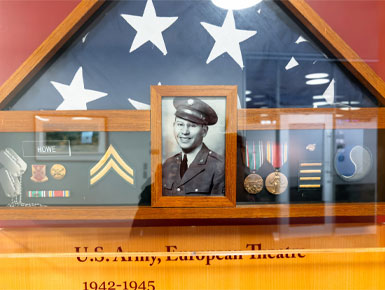
The exhibit honoring Howe includes a copper relief titled “War Dancer” received from donors in Rapid City and a shadow box containing the American flag that had been draped over his casket, created by USD alum Joe Williams ’07. The two pieces two important facets of his life, his work as a professor of art and his experience as a U.S. Army soldier. USD galleries developed the design, sourced the appropriate cases and created the supporting text for the display in collaboration with the Native American Cultural Center and USD Tribal Outreach.
The Galleries also worked with student services to include an exhibit of paintings titled “The Teachings of Shell Face: Oral Tradition in Oscar Howe’s Art,” curated by Delphine Red Shirt, Ph.D. Red Shirt serves as a lecturer in decolonized history and the Lakota language at Stanford University, presented the 2025 Oscar Howe Memorial Lecture and is a veteran of the United States Marine Corps. Alongside the paintings are Wacipi photos and Tiospaye posters created by students, curated by John Little with assistance from USD’s Archives and Special collections.
“We sometimes forget that there is a legacy of service in the armed forces within our higher education faculty and staff,” said Bruce Kelley, Ph.D., dean of the College of Fine Arts. “The work of veterans, their role on campus and the ways that they learn from us and we learn from them are very important to me. This display honors all USD veterans, whether students or employees, and pays particular respect to Native veterans within our USD community.”
In addition to Howe’s exhibit, two paintings by Cournoyer, “Untitled Bear” and “Quilts and Moccasins,” are displayed in student lounge areas in the MUC. These paintings were created with the Oscar Howe Summer Art Institute students during the 1990s.
Cournoyer, an enrolled member of the Oglala Sioux Tribe from Marty, South Dakota, has established himself as an influential contemporary artist, educator and advocate—following in the footsteps of his mentor Oscar Howe and expanding on Indigenous visual traditions in new directions. His artistic journey began after his discharge from the Marine Corps. As a scholar and administrator, he fosters connections among artists, cultural institutions and funding agencies guiding the next generation of Native artists. Like Howe, his practice and leadership continue to expand the possibilities of Indigenous art in the contemporary gallery sphere.
These exhibits embody the dynamic blending of cultural heritage, studio innovation and community engagement, exemplifying the mission of USD’s College of Fine Arts to sustain creative expression and cultural dialogue. They honor the work of veterans and remember that their impact can be felt both in their military service and their art.
“The University Art Galleries and the College of Fine Arts have a long history working with Native American artists and recognize that Native art is an essential part of the cultural identity, history, and contemporary creative life,” said Amy Fill, the gallery director of the College of Fine Arts. “Our relationship with Native artists is deeply rooted in the Oscar Howe Legacy. Howe believed that Native artists should have the freedom to communicate cultural traditions and individual creativity and believed in the importance of educating future generations of artists.”
She continued, “Though exhibitions and educational programs such as the Oscar Howe Summer Art Institute, the Oscar Howe Memorial Lecture, the Oscar Howe Gallery, the Oscar Howe Data Base and the Howe Legacy Exhibition series, we hope to encourage conversations, create opportunities for artists to share their experiences, traditions and perspectives across communities, generations and cultures. Many of the Native and Indigenous artists we work with have connections to USD, Oscar Howe, Robert Penn and the generations of artists who followed him. We want to honor those connections while continuing to build new ones.”
You May Also Like

Haarberg 3D Center Awardee’s Journey to Advance Cancer Therapies
Kristi Egland, associate professor at the Sanford School of Medicine at the University of South Dakota and chief science officer/co-founder of Poly Solutions, LLC, discovered research as a career path her first year in college.

Martial Music: USD Alumnus Brian Mann and Service Through Song
Founded in 1931, the University of South Dakota College of Fine Arts has long represented hope, inspiration and the power of the arts as a catalyst for change that spans across state lines.

USD Kinesiology and Sport Management Students Apply Learning Through Community Partnerships
For students in the University of South Dakota’s kinesiology and sport management program, learning about exercise intensity and program design goes beyond the classroom.
