
Capitol Hill Excellence

Small school. Big Benefit.
A conversation with Jackie Barber, J.D. ’06, 35th Secretary of the U.S. Senate, about how the USD Knudson School of Law impacted her life.
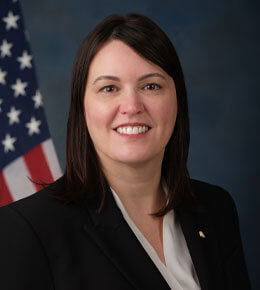
What does your job entail?
I currently serve as the 35th Secretary of the Senate. I was nominated for this position by Majority Leader John Thune and was elected by the Senate on Jan. 3, 2025. The Secretary of the Senate is an elected officer responsible for 250 employees in 26 departments that assist with the day-to-day operations of the U.S. Senate.
The Secretary keeps the legislative records of the Senate, receives and transmits official messages to and from the president and the House of Representatives, and is responsible for the records of Senators’ elections. The Secretary is also the chief financial officer of the Senate and is responsible for a large number of administrative offices that cover a wide range of services, including the Senate Library, the Gift Shop, the Historian’s and Curator’s offices, and the Page School.
What does a working day-in-the-life look like for you?
The first Secretary of the Senate, Samual Otis, was elected in 1789 and recorded the proceedings of the Senate in his own hand. That responsibility now lies with one of the 26 departments within the Office of the Secretary. It is perhaps not a surprise that with so many different departments, there isn’t really a typical day in the life of the Secretary, but there are some activities that mark each day.
I am typically present in the Senate Chamber for the opening of each day’s session. Standing on the Senate floor each day is a reminder of what an honor this position is—in fact, a seat beside the presiding officer is reserved for the Secretary and, in certain parliamentary circumstances, the Secretary may preside over the Senate. My days are punctuated by clerks delivering bills or confirmations for my signature, as every act passed and nomination confirmed by the Senate is examined and signed by the Secretary.
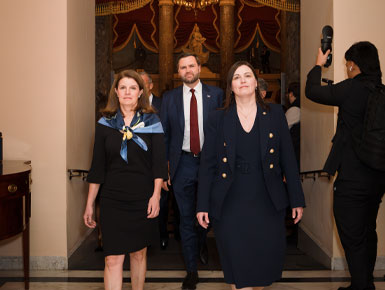
After opening, each day brings a unique set of meetings and issues to work through. I may be in meetings with individual departments discussing hiring, budgets or the on-going work of each department. I may be meeting with oversight committees or with other Senate officers to collaborate on improving Senate operations, attending briefings or participating in project walk-throughs.
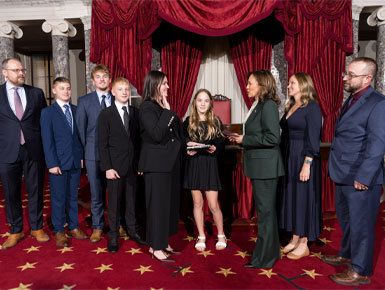
There is also a ceremonial aspect of this position. The Secretary assists with leading the Senate to events in the House Chamber, such as the electoral count and joint addresses to Congress, and to state funerals in the Capitol Rotunda. I also participated in the Inaugural Ceremonies and have the honor of presenting each new class of Senate Pages with their pins.
Days can be quite long—and in several instances this year have gone through the night—and are very rewarding.
What is your favorite memory from your time in law school?
Every year the Student Bar Association selects the recipient of the McKusick Award to honor exceptional service to the legal community. In 2005, as Student Bar Association President, I was responsible for presenting the award. The recipient that year was David V. Vrooman, J.D. ’56.
Mr. Vrooman’s nomination letters were filled with touching stories of the ordinary and extraordinary ways he assisted others in the legal community.
He was always willing to step in and assist other attorneys with their cases when they were going through personal hardships. His willingness to take on the additional work was even more impressive because he was a solo practitioner. When I called to let him know that he had been selected, he was overjoyed and shared with me that this award was particularly meaningful to him because he knew Marshall M. McKusick, the award’s namesake. He then quipped that every attorney in his firm was elated by our choice!
I am fortunate to have met Mr. Vrooman. I still keep the letters he sent me in 2005 and read them from time to time. Twenty years later, his selflessness and joy continue to inspire me.
What professors, courses or events have had a lasting impact on you?
Judge Robert Ulrich was my trial techniques professor and invited me to be on the trial team. While I didn’t ultimately become a trial attorney, the lessons he taught us about how to present a case have stayed with me over the years. He helped improve my presentation style both in substance and in practice, once requiring me to stand on a piece of paper while giving my opening statement, to help me overcome my nervous and distracting habit of pacing while speaking publicly.
Professor Frank Pommersheim was my Indian Law professor. He took his classes to practice in Rosebud Sioux Tribal Court for one day during the semester. I learned a lot about the operation of tribal courts on that day, but it is the warm hospitality of the Court’s judge and staff, as well as the meal that we shared in the Court’s offices, that have stayed with me all these years. Separately, I am still delighted when a few times a year I receive a card of Professor Pommersheim’s poetry in the mail.
Professor Roger Baron memorably called on his civil procedure students to consider whether the personal experiences that we may want to share in class were moving the lesson or conversation forward. More often than not, they weren’t. He called that urge to share a “false sense of personal relevancy,” and the class laughed at his very memorable turn of phrase.
How did USD’s law school community support you?
After law school, I moved to Washington, D.C. At the time, I was interested in government, but I didn’t have a clear vision for a career path or a job secured, which was stressful. Last year, in preparation for speaking at the law school’s hooding ceremony, I dug through my old emails and found a wealth of support from the USD Law community, including forwarded job postings and emails connecting me to other South Dakotans in Washington, D.C., and words of encouragement.
The faculty and staff at the law school and the broader South Dakota Bar community were so supportive and willing to help, even though I wasn’t in South Dakota and wasn’t certain what I wanted to do.
The legal education and the connection to this law school don’t end when you receive your diploma. Many times over the years I have reached out to my former professors and former classmates and asked for advice or referrals for myself, family or friends. I have always received prompt responses.
USD may be a small law school, but that is a big benefit. The professors know each student and are willing to invest in them and foster a continued connection, both in the classroom and long after you leave.
What are some things you are proud to say you have accomplished?
No accomplishment happens in a vacuum, especially on Capitol Hill. Prior to becoming Secretary, I was counsel to a number of congressional committees in both the House and the Senate. In those roles, I was part of teams that successfully navigated institutional challenges and achieved the passage of bipartisan legislation, including the operation of the Senate during the pandemic, the planning and execution of the 59th Inaugural Ceremonies, the passage of the 2018 farm bill and the passage of the Electoral Count Reform Act.
I am proud of these accomplishments, but I am even prouder of the teamwork that got each one of these things across the finish line.
Do you have any advice for the 1Ls at the USD Knudson School of Law and individuals who are just beginning their legal careers?
Rewarding careers are not always linear. Don’t be afraid to take interesting opportunities. USD’s law school gave me a sound legal education on which to build my career, and the faculty, staff, my law school classmates and members of the South Dakota Bar gave me a lot of support along the way.
That education and support, combined with a willingness to take the path less traveled, provided me with opportunities that have been incredibly fulfilling. It is often surprising how one opportunity leads to another. One day you too might find yourself in a position that is the honor of a lifetime.
Statutes, Strategy and Small-Town Roots
Logan Hollers, J.D. ’10, is a climate and energy lobbyist with Invariant LLC, an advisory firm in Washington, D.C. He has over 10 years of experience in environmental law; however, when he first started college, he thought he would become a doctor.

During his undergraduate career at the University of South Dakota, Hollers took Intro to Criminal Justice with Professor Emeritus Mike Roche, J.D., S.J.D.
Hollers said, “He [Roche] completely changed my worldview and made me realize that my talents could be utilized to impact public policy and attempt to make the world a better place.”
Following that course, Hollers felt attending the USD Knudson School of Law was the clear choice and a natural evolution of his academic career.
“It was an excellent intro to the study of laws and legislation. Behind every statute is a story,” said Hollers. “I still utilize lessons I learned at USD Law.”
When Congress is in session, those skills can be seen on Capitol Hill. Hollers spends days connecting with congressional members about ongoing environmental policy debates while also establishing goals with Invariant LLC clients.
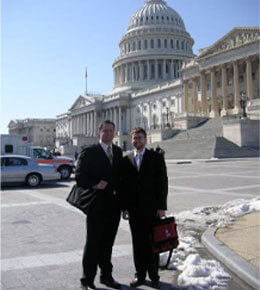
He credits the USD Knudson School of Law with offering him a wide range of opportunities.
In addition to exploring law in the classroom, Hollers was a member of the Moot Court and Trial Team. With over 30 student organizations, each centered on sections of the legal profession, USD’s law school provides students with a modern law education in a small town location. The smaller aspect of the school prompts an innate sense of camaraderie and ensures each graduate carries their authentic selves into the practice of law.
“The Midwest attributes of pragmatism, kindness and plain-spokenness have helped set me apart in a city that’s rife with subject matter experts,” said Hollers.
Outside of his legal expertise, Hollers is a baseball fanatic and father to three young girls. Of the two accomplishments, he specifies a particular pride in the latter.
Capitol Hill Champion to the Farmer
Growing up on a farm in Aberdeen, South Dakota, Kelcy Schaunaman, J.D. ’20, witnessed the rewards and challenges that farmers experience first hand.

Now, as the manager of competition, tax and labor at the National Pork Producers Council in Washington, D.C., Schaunaman has the opportunity to give back to this industry and support the communities she was raised in.
An average work day for her includes lobbying members of Congress on behalf of pork producers across the nation. Her dedication to that cause and the skills she brings to her role have been built over the course of her career.
Prior to her work with the NPPC, Schaunaman was an associate counsel and legislative assistant in the House Committee on Agriculture and then a senior policy advisor at the U.S. Department of Agricultural Farm Service Agency—a role that connected to Schaunaman’s roots.
“It was an honor to work on behalf of farmers and ranchers across the country at the U.S. Department of Agricultural Farm Service Agency,” said Schaunaman.
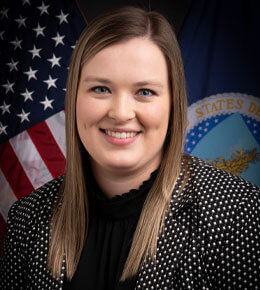
Before she discovered this career serving farmers and the agriculture industry, however, Schaunaman got her start as a student intern for Senator Heidi Heitkamp while pursuing her undergraduate degree. It was then she realized what having a law degree could mean for her career. Schaunaman began attending the USD Knudson School of Law in 2017.
“Going to law school in the Midwest gives me a different perspective,” said Schaunaman. “Growing up on a farm and having been a part of rural communities shapes how I think about policies and the people they impact.”
Today, skills like legal writing and connections made through USD Women in Law and the USD Agricultural Law Society (Schaunaman founded this student organization) are still relevant to and active in her life. Some of the most impactful lessons she learned at USD’s law school were gained outside the classroom.
She credits those hands-on experiences with shaping her path and encourages first-year law students to embrace every opportunity that comes their way.
“USD Law prepared me for my career by pushing me outside of my comfort zone with all of the new opportunities,” said Schaunaman.
You May Also Like

Legal Learning: South Dakota Supreme Court Convenes at USD
The South Dakota Supreme Court travels through the state twice a year to hear oral arguments at public institutions, giving the public an opportunity to observe the court in action. Each year, the court holds one of their sessions at the University of South Dakota Knudson School of Law.

USD Professor Tom Mrozla Wins National Teaching and Mentorship Award
Thomas Mrozla, Ph.D., associate professor of criminal justice and the criminal justice program coordinator at the University of South Dakota, has been honored with the American Society of Criminology Division of Policing Teaching and Mentorship Award.

USD’s Master of Public Health Program Achieves Reaccreditation
The University of South Dakota and South Dakota State University’s joint Master of Public Health (MPH) program has been granted reaccreditation for a seven-year term, the maximum given, by the Council on Education for Public Health (CEPH).
