
The Science Behind Human Movement

Hyung Suk Yang, Ph.D., assistant professor in the Division of Kinesiology and Sport Management, researches biomechanics: a science that mixes biology and physics to consider how mechanical forces and biological systems interact. For Yang, that means studying how human bodies move.
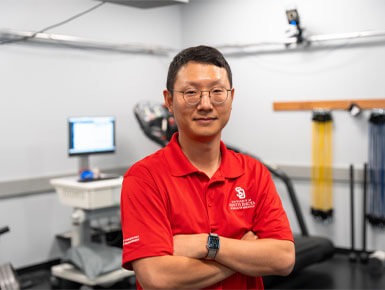
“Growing up, I liked sports and the science part of it—especially high-tech shoes or different equipment that can help or improve performance,” Yang said, reflecting on his journey to studying biomechanics. “The research equipment at USD was a perfect setup for me.”
Now, Yang uses the newest technology in USD’s kinesiology research lab to study walking and mental fatigue—two areas with significant impacts on everyday life.
Research With Real- World Impact
In one study, Yang discovered that walking with small weights improved walking performance, allowing participants to walk faster without sacrificing balance or symmetry.
This held true when studying stroke patients—a common demographic of people needing to re-learn how to walk. Research like Yang’s has real-world ramifications for how doctors and physical therapists approach patients building muscle function and learning or re-learning basic movements.
Studying mental fatigue, Yang found that being worn-out mentally did not affect strength but did affect endurance. In other words, people quit early when they’re tired. Yang said, “It’s the body-mind connection. Exhaustion is not just in the mind, but it actually affects physical performance.”
This research impacts sports and everyday life in addition to affecting how health care professionals approach rehabilitation.
“When people are going through an injury or a chronic condition, their mental health is definitely lower. They’re under a lot of pressure,” Yang said. “When we are trying to improve their function, it’s not just physical, but we have to consider the mental side of it.” Taking into account how mental fatigue impacts patients allows health care providers to provide more holistic care.
Some of Yang’s biomechanics research involves working with student athletes. One such study worked with the USD women’s soccer team to see how mental fatigue affected landing. Another used biomechanics to tweak how athletes land when sprinting to help prevent hamstring injuries, making them safer on the field.
USD’s state-of-the-art technology makes Yang’s research into gait and mental fatigue possible.
In 2025, USD doubled the value of the equipment available for teaching and research in kinesiology. The lab is now equipped with a 3D motion capture system, force plates, an electromyography system, a BodPod for measuring body composition, a metabolic cart for measuring energy expenditure, treadmills, stationary bikes, weights, functional movement testing kits and a wide range of exercise equipment.
“Now we can quantitatively measure their motions or movements. We can quantitatively measure how fast they’re moving and what angles they have,” Yang said.
Connecting Students to Opportunities
One draw of his current role at USD was the ability for Yang to mentor students.
“I was excited to come to USD because, as a faculty member, I have a good combination of teaching and research,” Yang said. “I liked doing both, and USD was offering that opportunity.”
From recruiting research participants, to assisting with data collection, to running statistics—students working with Yang learn the intricacies of conducting experiments. This experience helps them understand the science of movement as a project of creating knowledge that has real-world impact on health care and sports.
Sydney Conley ’25, ’24, a USD graduate who earned a B.S. and an M.A. in kinesiology and sport management with specializations in exercise science, is one of those students.
“While I was working toward my master’s, I had the option of completing a thesis or taking elective courses, and I ultimately decided to move forward with a thesis. I had a lot of guidance from Dr. Yang,” Conley said. “What was most meaningful to me about working in the kinesiology research lab was the opportunity to take what I was learning in the classroom and apply it in a hands-on environment. I was also able to gain experience working with so many different equipment and technologies.”
Conley is now an instructor at USD in the kinesiology and sport management division. She credits her participation in research with her successful transition into the role.
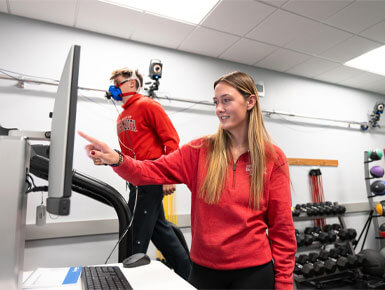
“Working in a research setting helped me understand how data is collected, analyzed and interpreted, which translates directly into how I teach students to think critically about evidence in our field. Because kinesiology and sport management is such a broad field and I’m still exploring where I want to land long-term, getting exposure to so many different tools and protocols was especially impactful,” Conley said. “Having this exposure and experience with high-tech equipment prepares me to go almost anywhere in the field and succeed.”
As one of USD’s most popular majors, the kinesiology and sport management program prepares students with the skills and hands-on experience to thrive in their careers. They leave not only with career-readiness, but also with the opportunity to contribute to something bigger than themselves.
“Something that can be new to students is the idea that research is creating new knowledge,” Yang said. “We’re not just passively consuming things; we have the responsibility of producing something new to advance the knowledge, and that’s important.”
You May Also Like

South Dakota Launches ‘Rural Health Forward’ to Strengthen Rural Healthcare Workforce
South Dakota has launched Rural Health Forward, a new statewide initiative to strengthen rural healthcare workforce training and support. This initiative is funded through the federal Rural Health Transformation Program (RHTP) grant that supports expanded access to high-quality healthcare in rural areas statewide.

USD President Sheila K. Gestring Announces Retirement
After nine years leading the University of South Dakota, President Sheila K. Gestring has announced her retirement, effective June 21, 2027.

Avera, SDSU and USD Sanford School of Medicine Establish Statewide NIH Research Partnership
The National Institutes of Health awarded $11,090,204 over five years to establish the South Dakota Center for Advancing Clinical and Translational Research (SD-ACT), a statewide partnership among Avera Research Institute, South Dakota State University and the University of South Dakota Sanford School of Medicine.
