
USD School of Education Professor Publishes New Book

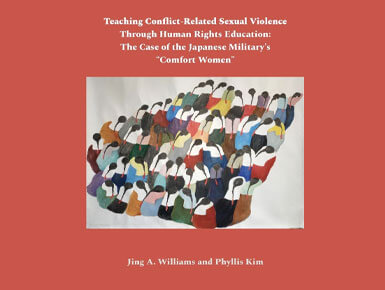
Williams’ book, which was co-authored by Phyllis Kim and published by the National Council for the Social Studies, is the first English-language book for secondary social studies teachers focused specifically on teaching conflict-related sexual violence, guiding them on how to approach conflict-related sexual violence, like comfort women, in secondary schools. “Comfort women” refers to the girls and women who experienced sexual violence under the Japanese Imperial Army during World War II.
“This book goes beyond the history of the Japanese military’s comfort women and is designed to support teachers who may feel uncertain or unprepared, providing both context and actionable tools,” said Williams. “It’s organized into five chapters: History, Denial, Responses, Resistance, and Remembrance. Each chapter begins with a global perspective on conflict-related sexual violence, then focuses on the ‘comfort women’ history, and concludes with a ready-to-use, step-by-step lesson plan."
The lesson plans, Williams continued, are classroom-tested and include complete teaching resources and materials, so educators don’t have to start from scratch, while also avoiding graphic images and language.
Ultimately, the goal is to help students engage with this history through a human rights education framework, fostering empathy and critical thinking without overwhelming them with trauma. At the same time, it gives teachers the confidence to approach sensitive topics in a way that is both respectful and pedagogically sound.
“We use the Japanese military’s ‘comfort women’ as a lens to help teachers approach the broader issue of conflict-related sexual violence in their classrooms,” said Williams. “Before this book, there were no English-language books to guide educators in addressing this difficult subject. Now, it provides teachers with the tools they need to break the silence and teach history responsibly and effectively. We are deeply grateful to the National Council for the Social Studies for their support.”
From Research to Publication
Williams’ focus on conflict-related sexual violence—specifically the “comfort women” system—evolved over time. While researching the Nanjing Massacre, she observed the widespread sexual violence against women and girls, which naturally led her to study the Japanese military’s “comfort women” system.
“From there, I connected with scholars in the U.S. and abroad who shared this interest,” she said. “We began collaborating on teaching and research projects—one of which eventually became this book. It represents years of work and is, by far, my proudest accomplishment.”
Williams hopes the book will inspire more history teachers worldwide to include this topic in their classrooms. According to her, doing so will “not only enrich their lesson plans but also honor the victims and help ensure that such tragedies never happen again.”
Williams also said the book is intended to help educators break the silence around difficult histories.
“This topic has long been considered taboo in many cultures, including the U.S.,” she said. “If we don’t learn from history, history will repeat itself. Silence does not protect students—it only allows these injustices to continue.”
You May Also Like

Avera, SDSU and USD Sanford School of Medicine Establish Statewide NIH Research Partnership
The National Institutes of Health awarded $11,090,204 over five years to establish the South Dakota Center for Advancing Clinical and Translational Research (SD-ACT), a statewide partnership among Avera Research Institute, South Dakota State University and the University of South Dakota Sanford School of Medicine.

USD Philosopher Joseph Tinguely Awarded John Templeton Foundation Grant
Joseph Tinguely, Ph.D., was recently awarded a grant from the John Templeton Foundation in the amount of $435,790. This grant will support him as he organizes interdisciplinary collaborators with the aim of producing a conference, an edited manuscript and a series of public-facing media.

Educators Rising Day Welcomes Future Educators, Inspires Next Generation
The University of South Dakota welcomed approximately 150 high school students from 12 schools across South Dakota and Nebraska on Sept. 23 for Educators Rising Day, an event designed to introduce students to careers in education and help them explore their future as teachers, leaders and advocates.
