
USD’s Jing Williams Publishes New Book on the Pedagogy of War

The upcoming book emphasizes the importance of teaching about global wars as a social studies teacher in grades 6-12. Readers will find lesson planning examples, teaching strategies, teachers’ reflections and additional teaching resources on specific wars.
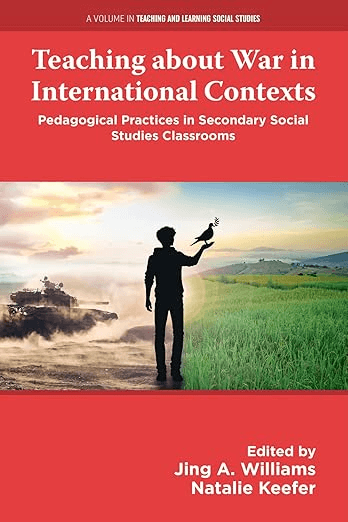
Williams sat down with us for a conversation about her book and the impact it will have on social studies classrooms.
What motivated you to contribute to or help shape “Teaching about War in International Contexts,” and what gap in the field were you hoping to address?
I was motivated by a persistent challenge in social studies education: While war is unavoidable in the curriculum, it is often taught as a series of disconnected events defined by dates, places and outcomes. Both my teaching and research have shown that this approach limits students’ deeper understanding of conflict and its enduring consequences.This book responds to a clear gap in the field. While there are many resources focused on teaching specific wars, there has been little attention to the pedagogical practices needed to teach war as a global phenomenon across contexts. By bringing together international perspectives and classroom-tested strategies, the book aims to support educators in moving beyond isolated narratives and toward more meaningful, globally informed teaching about war.
The book emphasizes teaching war as a global and contextual phenomenon rather than isolated historical events—how do you define that shift through pedagogical approach?
In this book, we shift toward understanding war as a global, interconnected phenomenon shaped by cultural, political and economic forces across regions and time. This means situating wars within broader contexts, such as colonialism, nationalism and international relations, as well as examining how different societies experience and remember conflict.Pedagogically, this shift encourages students to engage with multiple perspectives, recognize global interdependence and understand how war continues to shape identities, communities and geopolitical realities today.
How does the book balance the need to teach factual historical content with the goal of encouraging critical thinking about complex themes?
The book does not abandon factual knowledge; rather, it uses it as a foundation for deeper inquiry. Students still learn key historical details, but they are also encouraged to examine how those facts are interpreted, whose perspectives are represented and what narratives may be missing.Across chapters, contributors provide strategies that prompt students to analyze primary and secondary sources, evaluate competing interpretations and question dominant narratives. In this way, factual knowledge becomes a starting point for building critical thinking skills rather than an endpoint in itself.
To support educators, the chapters offer practical strategies that help teachers address sensitive content in ways that are both ethically responsible and pedagogically meaningful.
The book includes voices from teachers, former teachers and teacher educators—why was it important to include this mix of perspectives?
Including this range of voices was essential because teaching about war is not only a theoretical issue; it is deeply practical. Classroom teachers bring firsthand experience with students, curriculum constraints and instructional decision-making.By integrating perspectives from current and former teachers, alongside teacher educators, the book bridges theory and practice. This ensures that the strategies presented are classroom-tested, realistic, and directly applicable to educators’ everyday work.
If a secondary social studies teacher has only one takeaway from this book, what would you want it to be?
The key takeaway is that teaching about war should go beyond memorizing facts; it should help students understand complexity, question narratives and engage with global perspectives. When students examine war through multiple lenses and contexts, they develop not only historical knowledge but also the critical thinking and civic awareness needed to navigate today’s world.At its core, this book is about helping teachers navigate one of the most challenging yet essential topics in social studies education. War is not only a historical phenomenon—it is something that continues to shape our world.
By equipping educators with meaningful strategies and global perspectives, we hope to support the next generation of students in developing deeper understanding, empathy and critical awareness about conflict and peace.
As a USD faculty member, how does your work on this book connect to your teaching and research with USD students?
At USD, my teaching and research focus on preparing future social studies educators to engage students in meaningful learning. This book reflects those same goals by emphasizing critical thinking, global perspectives and the thoughtful teaching of complex topics.The work directly informs my courses by providing examples and frameworks that I can use with USD students as they learn how to design effective and inclusive social studies instruction.
In what ways do USD’s teacher education programs influence or align with the pedagogical approaches highlighted in the book?
USD’s teacher education programs emphasize reflective practice, critical inquiry and student-centered instruction, all of which align closely with the pedagogical approaches highlighted in the book. The book’s focus on multiple perspectives and engagement with complex issues mirrors the program’s commitment to preparing educators who can foster critical and informed citizenship.What opportunities exist at USD for pre-service teachers to engage with topics like war and conflict in ways reflected in the book?
USD provides multiple opportunities for pre-service teachers to engage with issues such as war and conflict through coursework, field experiences and classroom-based inquiry projects. In these settings, students are encouraged to explore complex global issues, work with different perspectives and develop instructional strategies that reflect the approaches highlighted in the book.You May Also Like

USD Professor Tom Mrozla Wins National Teaching and Mentorship Award
Thomas Mrozla, Ph.D., associate professor of criminal justice and the criminal justice program coordinator at the University of South Dakota, has been honored with the American Society of Criminology Division of Policing Teaching and Mentorship Award.

USD’s Master of Public Health Program Achieves Reaccreditation
The University of South Dakota and South Dakota State University’s joint Master of Public Health (MPH) program has been granted reaccreditation for a seven-year term, the maximum given, by the Council on Education for Public Health (CEPH).

SPURA Students Present at 2026 Eastern South Dakota Undergraduate Research Symposium
Eight undergraduate researchers participating in the University of South Dakota’s Summer Program for Undergraduate Research in Addiction (SPURA) finished a productive summer of research by presenting their work at the 2026 Eastern South Dakota Undergraduate Research Symposium.
