
A Soundtrack of History: USD’s National Music Museum Celebrates America’s 250th

For the National Music Museum, located on the campus of the University of South Dakota, historical periods come to life as audiences experience firsthand the craftsmanship and cultural significance of over 14,000 instruments that have influenced music across centuries and continents.
A museum dedicated to research, teaching and preservation, the NMM shares stories of instrument creators, players and collectors from throughout history and holds an archive of catalogues, brochures, photos and more—making it one of the only musical museums with a direct, historical connection to original instruments.
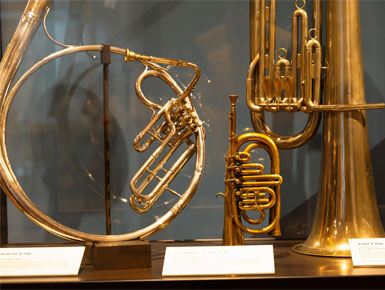
Additionally, the NMM has been an epicenter for musical instrument research, holds the only graduate degree in musical instruments in North America and contains a library of musical holdings that range from celebrity guitars to priceless Italian violins—each one with its own special anecdote.
“There are so many stories to learn, uncover and preserve through musical instruments,” said Michael Suing ’22, ’09, ’04, NMM deputy director of collections and co-curator of the special exhibition, “Of Thee I Sing.” “The instruments are one access point to the past, to the lives of those who came before us. By preserving and studying them, we might better understand ourselves and our ancestors.”
With historical accuracy at the forefront, especially as the United States celebrates the 250th anniversary of the signing of the Declaration of Independence, the NMM strives to provide its audience with exhibits that capture history while inspiring and educating the modern visitor.
“We try to balance historical accuracy while creating engaging exhibitions to help us better understand ourselves, our cultures and our communities,” said Suing. “We designed the exhibits for broad access, allowing many entry points for discovering something about the history of musical instruments and music in general. In our special exhibition gallery, we’ve been lucky to alternate topics to meet a range of visitor interests and experiences. We are lucky to steward them all and keep their stories intact for future generations.”
For permanent galleries, the NMM chose broad themes, which enabled the museum to rotate objects within a given display, many of which are old, rare and historically important instruments within the collection. There are also those of more recent manufacture, shaping how music is made and enjoyed today.
“We’ve gone through great lengths to consider multiple ways of understanding or approaching the history and study of musical instruments,” said Suing.
Visitors can also engage with collections through videos, sound samples, first-person musician narratives, interactive instruments, the mobile media app or the jukebox in the guitar galleries. For children, the NMM features a variety of interactive play areas equipped with music-making activities, as well as coloring pages specifically designed to explore cultures and the corresponding special exhibitions.
In addition to its one-of-a-kind experience, the NMM supports research, as well as provides educational opportunities and concerts for its visitors.
“We want to make the museum accessible in the broadest terms. We have many collaborations and research projects just waiting to be realized,” said Suing. “Determining who and how each of these potential projects will impact our constituents is so important to us. Some may cater to expert audiences like builders and scholars, while others cater to children and families. We do our best to represent and reach each community we serve.”
“Of Thee I Sing”: A Celebration of America’s 250th Anniversary
In spirit of reaching the community, the NMM has recently opened a temporary exhibit, “Of Thee I Sing: Origin, Heritage and Patriotism,” to celebrate America’s 250th anniversary.
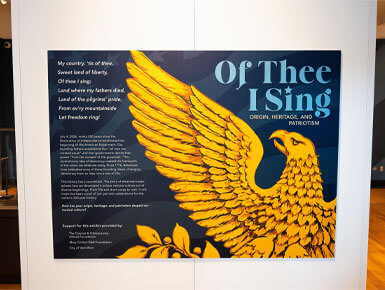
The special exhibit explores themes of origin, heritage and patriotism in the United States through musical instruments, their makers and the traditions they represent. The exhibition also features 30 instruments connected to Native American cultures, the colonial period in North America, immigrant innovators of the 19th and early 20th centuries and instruments decorated with patriotic imagery.
Two of these instruments, the Taylor Liberty Tree Guitar and the Cluxton Gourd Fiddle, have also been featured nationally in the Library of Congress Collecting 250 online exhibit.
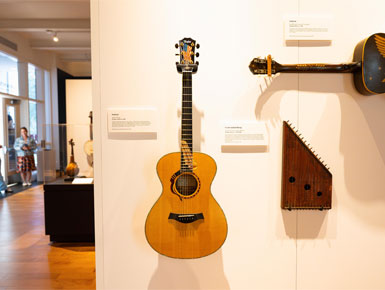
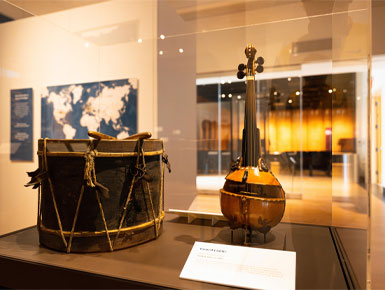
Anna Van Kley ’24, NMM museum educator and co-curator of the special exhibition, emphasized that this exhibit reflects the broader political and cultural influence of America throughout history.
“American music history blended the cultures of immigrants and Indigenous people to create different musical genres like rock ‘n’ roll, rap and jazz, which are now popular throughout the world,” said Van Kley. “The exhibits emphasize the idea that American music history shares important concurrent themes with broader American history. It illuminates how people’s experiences with music have shaped our lives throughout human history.”
The NMM is open Tuesdays through Saturdays from 10 a.m. to 4 p.m. For more information, please visit the NMM website.
About the National Music Museum
Located on USD’s main campus in Vermillion, South Dakota, the National Music Museum is home to a collection of more than 14,000 musical instruments spanning five centuries and every corner of the globe. The NMM was founded as a partnership with USD, which provides staff and facilities for preservation, teaching and research.
You May Also Like

Legal Learning: South Dakota Supreme Court Convenes at USD
The South Dakota Supreme Court travels through the state twice a year to hear oral arguments at public institutions, giving the public an opportunity to observe the court in action. Each year, the court holds one of their sessions at the University of South Dakota Knudson School of Law.

USD Professor Tom Mrozla Wins National Teaching and Mentorship Award
Thomas Mrozla, Ph.D., associate professor of criminal justice and the criminal justice program coordinator at the University of South Dakota, has been honored with the American Society of Criminology Division of Policing Teaching and Mentorship Award.

USD’s Master of Public Health Program Achieves Reaccreditation
The University of South Dakota and South Dakota State University’s joint Master of Public Health (MPH) program has been granted reaccreditation for a seven-year term, the maximum given, by the Council on Education for Public Health (CEPH).
