
Honoring a Voice for the Black Hills: Anna Van Kley’s Thesis Earns USD’s Top Graduate Recognition

The nomination came from Molly Rozum, Ph.D., associate professor in the Department of History, who praised Van Kley’s work as “accessibly and engagingly written.”
“Her stories add up to a spectrum of wilderness thought that enhance and complicate what history records about early 20th century conservation and preservation,” Rozum said. “Her thesis is thoroughly researched and well written. She makes important and original contributions to the fields of environmental and regional history.”
For Van Kley, the recognition is both humbling and affirming.
“I was deeply honored,” Van Kley beams. “I questioned whether my work was good enough for such an award, but I trusted Dr. Rozum’s opinion. It’s validating to know she thought my work was worth celebrating—even after I received my M.A.—and even more validating to hear that others agreed with her.”
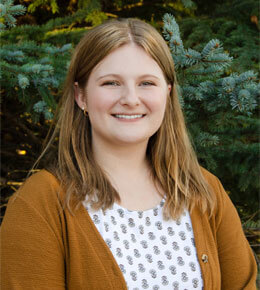
Van Kley, who received her M.A. in history, wrote a thesis that investigated the establishment of public preservation projects in the Black Hills, like Wind Cave National Park, Custer State Park and Mount Rushmore National Memorial. She looked at how different groups of people viewed the land and what inspired them to protect lands from industrial development.
“These South Dakota parks were established during national debates about the intrinsic and extrinsic value of protecting lands for the public,” stated Van Kley. “At the same time, these debates about conservation and preservation intersected with ideas of American nationalism, gender, colonialism and commercial development. The American West became an important symbolic and practical place to enact these ideas. As a result, my thesis looks at how South Dakotans contributed their ideas about preservation by embedding their perspectives into the parks themselves, as local debates determined what lands ought to be preserved and why.”
The Black Hills, she continued, became a locus of the debates due to the quantity of parks established in a relatively small area within a short amount of time.
“As a result, my thesis engaged with the region’s contributions to preservation ideology and park practice by looking into the establishment of the Black Hills park sites in relation to the national and regional conditions that favored or hampered preservation efforts,” she said.
Inspiration from Nature’s Own
The path to the Black Hills began 1,600 miles away, in Columbus, Georgia, where Van Kley spent her childhood and discovered an early fascination with historic places.
“I spent a lot of time going to museums and national parks as a kid on family vacations,” she reminisced. “My interests in history and social science were supported by my family, before I even knew how much they interested me.”
Those interests led her to pursue history and sociology from Berry College in Rome, Georgia. While getting her undergrad, she harnessed her love for national parks and was inspired by nature to work for the National Park Service as an interpretive park ranger.
During one of her sessions, she worked at Mount Rushmore, which taught her about the Black Hills and the history of its parks. Once she started researching national parks and environmental history, the rest became history.
“I realized that national and state park history intersected with so many other parts of history, which fascinated me,” she explained. “It allowed me to investigate American nationalism, gender ideas and economic interests in a way I had not considered before.”
Shaped by History, Positioned for the Future
During her studies, Van Kley received support and mentorship that strengthened her historical research skills and helped shape her future academic goals. With a teaching assistantship, scholarship and research grant, which allowed her to afford research materials, Van Kley’s financial stress was greatly reduced.
However, the USD faculty, she explained, were the most instrumental part of her experience.
“Dr. Rozum provided me with all the support I could have asked for. She knew about books that I could read to begin my research project and always had ideas about new avenues for research throughout the revision process,” said Van Kley. “Additionally, all of the history faculty helped me develop skills that made my work possible and gave me important advice on how I could achieve my goal. I feel like I owe my success to their support in a lot of ways!”
Van Kley also paid tribute to her overall time at USD, which has been “greatly influential” to her future goals and career path—allowing her to stay close to campus as the museum educator for the National Music Museum. The award recognition for her thesis reassures Van Kley as she considers future career opportunities.
“I’ve been working on an article for publication that comes from my thesis, and I believe this award will be a testament to the quality of my work,” she said. She also hinted at pursuing a doctorate in history, where the thesis award could set her apart from other candidates.
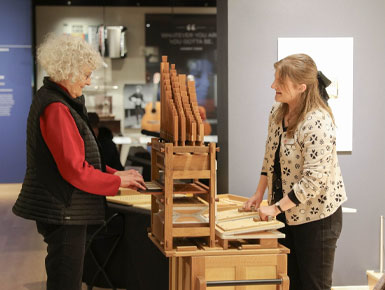
Going forward, Van Kley hopes more scholars will recognize the importance of Black Hills national and state parks in debates about preservation and conservation—something that, in turn, will help South Dakota’s economy and well-being.
“Many historical studies about public parks focus on ‘crown jewel’ parks, especially Yellowstone, Yosemite and Glacier,” Van Kley elaborated. “Other parks deserve more recognition as the debates about preservation and conservation didn’t end when those parks were established. The Black Hills examples both represent and complicate the debates about preservation and conservation that happened before and during their establishment and are thus important to include in the overall scholarship of environmental history.”
Van Kley was also selected as first runner up in the Midwestern Association of Graduate Schools/ProQuest Distinguished Master’s Thesis Award in Humanities, following her receipt of the Distinguished Master’s Thesis Award. She is the first USD student to be honored at the MAGS conference, taking place in March in Kansas City, Missouri.
You May Also Like

USD College of Fine Arts Announces New Piano & Music Technology Lab
The Department of Music at the University of South Dakota is unveiling a new named space this Oct. 9: The De & Dave Knudson Piano & Music Technology Lab.

Baack Named President of Sanford Research
Dr. Michelle Baack ’95, professor and chair of the University of South Dakota’s Sanford School of Medicine (SSOM) Department of Pediatrics and the Karl H. Wegner, M.D., chair in medicine, has been named president of Sanford Research.

USD Theater to Open Season Oct. 1 With ‘Stop Kiss’
The University of South Dakota’s Department of Theatre will present Diana Son’s “Stop Kiss” to open the 26-27 theater season, with performances Oct. 1-3 at 7:30 p.m. and a matinee performance on Oct. 4 at 2 p.m. in the Wayne S. Knutson Theatre.
