
USD Fosters the Liberal Arts Edge in the AI Era

These are the first sentences of the University of South Dakota’s online resource outlining the university’s position on and guidance for the use of generative AI—a type of artificial intelligence that uses large datasets to learn the underlying structure of information so it can generate original content.
At the core of this guide: the university’s commitment to human-centered learning, where AI tools can supplement, not replace, human activity.
This resource comes at a time in which higher education institutions are actively discussing the place of generative AI in the classroom. This spring, the South Dakota Board of Regents published a strategic set of objectives designed to position the state’s public universities to become leaders in adopting AI in higher education. Across South Dakota’s public university system, there is a shared commitment to engaging with AI intentionally and thoughtfully to prepare students for their careers. With experts in the humanities, the arts, ethics, business and other areas that will shape the future of AI, USD is well positioned to be a leader in this conversation.

At the helm of these discussions at USD is a 15-member AI steering committee, which spent the last school year surveying faculty, students, staff and other university stakeholders, meeting in subcommittees, and writing and reviewing the university’s AI guidelines before publishing USD’s AI resource online. Mandie Weinandt, director of USD’s Center for Teaching and Learning and instructor in the Beacom School of Business, chairs the committee.
While the committee’s work addressed all areas of the university and AI’s impact on privacy, accessibility and ethics, a central concern was related to how AI affects delivering and assessing knowledge in the classroom and preparing students for their lives after graduation, Weinandt said.
“We’re providing the resources to make sure AI is being used in productive, ethical and responsible ways,” she said.
Weinandt said the committee’s AI resource offers guidance for faculty and students about setting their own classroom policies and practices regarding use of the tools. Each industry has responded to the emergence of AI in unique ways, and classroom learning at USD reflects that; faculty are being intentional in how they bring that critical industry knowledge to the classroom while also recognizing what skills are best honed without AI.
To support that effort, the USD Center for Teaching and Learning offers workshops on the use of AI in the classroom—helping faculty think about how AI fits into teaching, assignment design, accessibility and discipline-specific learning goals. This intentional approach to training empowers faculty to stay current and innovative in an ever-changing landscape, while ensuring students receive an education that prepares them for today’s workforce.
“USD is taking a thoughtful and measured approach to AI to ensure our students are prepared to be innovative and responsible stewards of this technology,” Weinandt said. “We can’t pretend like we are sending students out into a world where AI is not a reality. AI is here to stay—and USD is shaping how tomorrow’s leaders will use it.”
Extending, Not Replacing, Student Thinking
One member of the AI Steering Committee is Young Ae Kim, Ph.D., professor of art in USD’s College of Fine Arts with expertise in graphic design and user experience (UX) and user interface (UI) design.
Kim has incorporated AI into her graphic design classroom, treating this technology as a collaborative tool rather than a replacement for human creativity. In her own practice, she explained that creative tools with built-in AI capabilities are part of her regular workflow. In committee discussions with colleagues in a wide range of disciplines, however, she encountered disparate opinions about AI.
“What stood out most during the committee discussions was how differently AI is understood across disciplines,” Kim said. “In some areas, the focus was on possibility and integration, while in others, it centered more on concerns around authorship, academic integrity and the boundaries of student work.”

The perspectives shared by her colleagues challenged Kim to look beyond her practical experience and evaluate the wider institutional impact of AI.
“One area that particularly expanded my thinking was equity,” she said. “If AI is already embedded in many professional tools—and if AI fluency is increasingly shaping students’ career trajectories—then differences in access, familiarity and confidence with these tools become critical concerns. Not all students, or faculty, are starting from the same place.”
As someone who actively engages with AI in her professional work and teaching, Kim said she would encourage colleagues to approach AI with curiosity rather than hesitation.
“It’s not necessary to possess comprehensive expertise before introducing AI into the classroom,” she said. “In many cases, faculty and students are navigating these tools concurrently, and this shared exploration can be pedagogically valuable.”

After graduation, students will find that AI is embedded in the tools they use in their professional lives, Kim said. “Recognizing this, faculty can begin by identifying where AI meaningfully supports learning objectives, particularly in areas such as ideation, drafting and critique. The emphasis should remain on extending student thinking rather than replacing it,” she added.
According to Kim, USD’s emphasis on close faculty-student interaction makes it easier to weave AI into the curriculum in intentional ways, ensuring students develop practical expertise and a critical understanding of the technology.
“Ultimately, higher education serves students best not by simply teaching them how to use AI, but by helping them understand its role, limitations and implications,” she said. “Preparing students for a future shaped by AI means equipping them with the judgment, adaptability and intellectual independence to engage with it thoughtfully— both in their careers and in their broader lives.”
Humans Still Matter
Reading literature, studying history and learning about different cultures provide insights into the human condition in all its ambiguity and uncertainty—insights unmatched by AI systems built on statistical probabilities. USD’s wide array of humanities programs cultivates the skills machines can’t easily replicate.
The Humanities Division is one of the three divisions in the College of Arts & Sciences and includes programs and courses in areas such as classical humanities, communication studies, English, Native American studies and philosophy, to name a few.

Skills taught in the humanities—like critical thinking, interpretation and ethical reasoning—are some of the few that are not being outpaced by AI, said Leah Seurer, Ph.D., interim associate dean of the College of Arts & Sciences and associate professor and chair of the Department of Communication Studies.
“A great example of this is in my own field of relational communication,” Seurer said. “AI cannot fully interpret and advise relational communication because it cannot think contextually. This thinking is what our discipline often describes as understanding the difference between a twitch and a wink.”
While AI may not perceive that kind of subtle distinction, the skills taught in the humanities empower students to think contextually and recognize and interpret that nuance.
The need for skills imparted in liberal arts classes expands with the growth of AI, Seurer added. “AI has no moral culpability or responsibility for the work it does. Skills like critical thinking and ethical reasoning become even more important for us to maintain and hone.”
She teaches students to evaluate AI critically, including their use of this technology in their own education. Seurer said students should ask themselves whether they’re using AI to replace a foundational skill, such as constructing and writing an argument. “Imagine going to the gym and asking someone else to lift weights for you and wondering why you aren’t strong at the end of the year,” she said. Just as one may move through discomfort in weightlifting to get stronger, Seurer explained, a student can hone their skills by practicing and being open to challenges.
“Turning in work you are a little unsure of, spending time engaging in that tedious process of drafting and editing a paper, being vulnerable and asking your professor for help when you don’t understand something doesn’t feel great, but it is how you get intellectually stronger.”
Seurer believes this intellectual strength is exactly what humans need in this new AI era.
“It will be up to us to consider the ethics of AI implementation, the sustainability of its use and the equity of its access, to name a few,” she said. “I fully believe that the skills garnered in humanities courses can equip students with the abilities to address these questions and challenges. Further, I believe these skills will set students up to be leaders in this new landscape.”
Teaching Future Teachers
The effect of powerful and widespread AI tools in the classroom is of particular interest to faculty and students in the USD School of Education. Preparing the next generation of K-12 teachers requires a pragmatic and forward-thinking mindset toward the intentional use of AI in the classroom.
“In our educational technology classes, which focus specifically on teaching with digital tools, we discuss the role of AI and both the affordances this technology creates, in addition to the challenges it also creates. There are always pros and cons with any technologies, and AI is no different,” said Dan Mourlam, Ed.D., chair of the Division of Teacher Residency & Education in the School of Education and an expert in educational technology.
In the school’s teacher preparation program, faculty identify ways that AI can enhance learning, such as tutoring and brainstorming lesson strategies.
“We have also engaged in discussions around those key issues such as how to prevent students from cheating with AI, issues with implicit bias, as well as inaccurate information or hallucinations that happen sometimes when using AI,” Mourlam added.
“This is in addition to creating experiences where our students use generative AI and develop key skills like prompt engineering, identifying hallucinations and detecting bias.”
When AI tools can provide a standard five-paragraph essay in a matter of seconds on nearly any topic, tailored for every grade level, teachers need to shift their pedagogical approaches to such assignments. Mourlam said the School of Education instructs their students to “AI proof” lessons to create assignments and assessments that don’t lend themselves to AI use.
“Tasks that achieve this typically require a performance (for example, presentations and in-class demonstrations), students’ voice or experience, or a focus on engaging students in critical thinking where they have to explain their thinking and defend their judgements,” he said. “Educators must now find ways that focus more on the thinking rather than only the final product.”
While AI does present challenges for educators, it also creates opportunities. For example, AI can be used as an adaptive technology for students with disabilities. Dyslexic students can use AI tutors designed specifically to address their challenges while building on their strengths. AI-powered eye-tracking allows users with severe physical disabilities to communicate and control technology. Mourlam said he has also seen educators create AI chatbots that help teachers find appropriate strategies for meeting student behavior needs.
“Ultimately, I do think that AI can help reduce some of the barriers students might have, especially if their teachers are adept at using AI in their instruction,” he said. “There’s really a lot of potential.”
Mourlam likens keeping up with the breakneck pace of AI development to flying an airplane while it’s still being built; in a time of rapid change, educators are faced with new challenges that have not been fully explored yet.
“There’s a huge need for teacher professional development, as well as research on the ways AI can be used effectively,” he said.
USD’s School of Education is involved in one such study assessing AI’s role in easing teacher workloads, with the goal of enhancing job satisfaction and teacher retention in under-resourced, rural areas. By engaging in this research, the School of Education is working to expand the current understanding of AI’s impact and potential while also preparing the next generation of teachers to thrive in this new landscape.
After Graduation: An Employer’s Perspective
The education USD students are receiving in how to use AI responsibly and thoughtfully has real-world relevance in the workforce. Careers are changing—and employers need leaders who can leverage human skills in a data-driven world.
“AI is definitely changing the shape of entry-level work, but it’s not as simple as jobs disappearing. What we’re really seeing is a shift in how work gets done,” said Steve Cross, vice president of artificial intelligence and generative AI at Old Republic International, an insurance company. Cross is also a member of the Beacom School of Business Advisory Council and regularly comes to USD to speak with business students about life after college and what skills employers seek from recent graduates.
The traditional foundation of entry-level roles—manual data collection, document review and basic analysis— is rapidly shifting toward AI-driven automation, Cross said. This creates new opportunities for people who can interpret and validate outputs and turn this information into real-world decision-making.
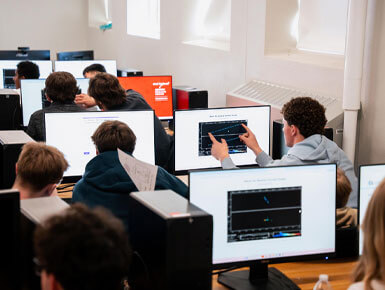
Using an example from his industry, Cross said an entry-level underwriter would previously have had to manually comb through complex, dense documents to perform an accurate risk assessment for an account. Now, generative AI tools can automatically extract and summarize the critical data from these files before the underwriter even opens them.
“Instead of spending hours finding the data, they spend their time analyzing what the data means for the risk profile of the account,” he said. “They can focus on high-potential accounts and complex dealmaking much earlier in their career, allowing them to develop the professional intuition that makes a great underwriter much faster than previous generations.”
Knowledge of how to use AI tools pairs well with a liberal arts education that prioritizes critical thinking, problem solving and strong communication skills, Cross said.
“AI is very good at producing answers, but it’s not inherently good at knowing whether those answers are right, relevant or appropriate. That’s where critical thinking comes in. The ability to question assumptions, evaluate sources and apply judgment is essential when working with AI systems.”
According to Cross, college graduates will benefit from knowing how to work with AI effectively, which includes knowing how to frame problems clearly and communicate with AI systems in a structured way.
“AI itself won’t take your job—but someone doing your job with AI just might,” he said. “The future belongs to the professionals who lean into these tools, learn how to use them responsibly, and combine them with strong human judgment to become far more effective than they were before.”
For USD students, that future promises opportunity. With an education grounded in human skills and strengthened with AI literacy, graduates are prepared not only to keep up with an AI-driven world, but to lead it.
You May Also Like

USD President Sheila K. Gestring Announces Retirement
After nine years leading the University of South Dakota, President Sheila K. Gestring has announced her retirement, effective June 21, 2027.

Avera, SDSU and USD Sanford School of Medicine Establish Statewide NIH Research Partnership
The National Institutes of Health awarded $11,090,204 over five years to establish the South Dakota Center for Advancing Clinical and Translational Research (SD-ACT), a statewide partnership among Avera Research Institute, South Dakota State University and the University of South Dakota Sanford School of Medicine.

USD Philosopher Joseph Tinguely Awarded John Templeton Foundation Grant
Joseph Tinguely, Ph.D., was recently awarded a grant from the John Templeton Foundation in the amount of $435,790. This grant will support him as he organizes interdisciplinary collaborators with the aim of producing a conference, an edited manuscript and a series of public-facing media.
