
Building on Strong Partnership, USD, Southeast Tech Create Expanded Pathway in Business Education

The agreement strengthens transfer pathways between the two institutions, allowing Southeast Tech graduates in several business-related associate degree programs to apply from up to 62 credits to up to 65 credits toward corresponding bachelor’s degrees at USD.
For students, the goal is a more seamless, affordable path from an associate degree to a bachelor’s degree. For employers, it is a way to strengthen the pipeline of business talent needed across South Dakota.
“The expanded partnership with Southeast Technical College creates a seamless route from an associate degree into a bachelor’s program at USD,” said Klaus Beckmann, Ph.D., interim dean of the USD Beacom School of Business. “By aligning our curricula and strengthening transfer pathways, we’re making it easier for students to continue their education without losing momentum or credits.”
Under the agreement, students who complete an Associate of Applied Science in accounting at Southeast Tech can apply up to 62 credits toward USD’s Bachelor of Business Administration in accounting. Students who complete the agriculture emphasis within Southeast Tech’s associate degree in business administration can apply up to 65 credits toward USD’s BBA in agribusiness leadership.
Other pathways include options for Southeast Tech graduates in business administration, human resource management and marketing, who can apply up to 64, 64 and 63 credits, respectively, toward corresponding USD business degrees.
“This expanded partnership is a natural fit for Southeast Tech because it advances our commitment to providing students with clear, affordable pathways to achieve their educational and career goals,” said Cory Clasemann, Ph.D., president of Southeast Tech. “Many of our students are looking for opportunities to enter the workforce quickly while also preserving the option to continue their education.”
The partnership builds on years of collaboration between USD and Southeast Tech, but leaders at both institutions said the expanded agreement reflects where higher education is headed: toward more flexible, connected pathways that meet students where they are.
That flexibility is especially important for students who may not begin college with a four-year degree in mind.
“One of the biggest benefits of these agreements is that they help remove barriers that may have discouraged some students from pursuing a bachelor’s degree,” Clasemann said. “For many students, starting at Southeast Tech provides a more affordable and accessible entry point into higher education.”
Once students gain confidence and experience success, continuing to a bachelor’s degree can become a more attainable goal, he said. The pathways also can benefit working adults and place-bound students balancing jobs, families and other responsibilities.
“By creating a clear road map from one institution to another, we can help more students see higher levels of education as achievable and worthwhile,” Clasemann said. “In that sense, these agreements are not just about transfer credits; they are about expanding opportunity.”

For USD, the partnership creates a stronger pipeline of career-focused students while helping meet regional workforce needs.
“Students who complete relevant associate degrees at Southeast Tech can transfer between 62 and 65 credits directly into corresponding business programs at USD, creating an efficient pathway to a bachelor’s degree,” Beckmann said.
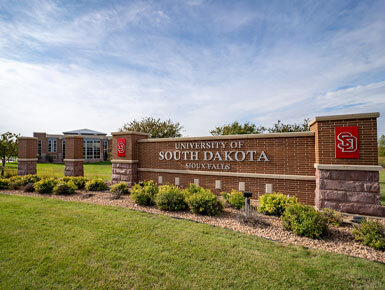
The Sioux Falls connection is also important. USD – Sioux Falls is located near Southeast Tech, making it possible for students who prefer a commuter experience to continue their education with little disruption. Several Beacom School of Business programs can be completed entirely through USD – Sioux Falls.
“This agreement helps remove many of those barriers,” Beckmann said. “One important advantage is geography.”
The two campuses are two miles apart and share a mission to serve greater Sioux Falls and prepare the future workforce in the community, added Jay Perry, Ph.D., vice president for USD – Sioux Falls.
“That makes us natural partners and collaborators. For STC graduates, there may come a time in their careers where they need additional education to expand their skills or receive a promotion,” Perry said.
“USD’s program can help those students build upon the foundation they received at STC. There isn’t a downside here: This partnership helps USD, STC, students and the local workforce.”
The expanded pathways come as demand remains strong for graduates in accounting, human resources, marketing, management and related business fields.
Southeast Tech continues to see strong interest in business programs because they provide versatile skills that apply across industries, Clasemann said. At the same time, many employers increasingly seek candidates who combine technical knowledge with broader business and leadership skills.
“While an associate degree opens the door to excellent career opportunities, a bachelor’s degree is often preferred or required for advancement into supervisory, management and specialized professional roles,” he said. “These articulation agreements help students meet those evolving workforce expectations by creating a clear and efficient pathway from an STC degree to a USD bachelor’s degree.”
Beckmann echoed that statement, pointing to the range of roles business graduates fill.
“Demand remains strong across all these disciplines because every organization depends on people with business expertise,” he said.
Accounting graduates support financial reporting, auditing, compliance and strategic decision-making. Human resource professionals help organizations recruit and retain talent. Marketing professionals drive customer engagement, brand development and growth. Management graduates provide leadership and operational oversight.
“These are foundational roles in virtually every industry, which means graduates have opportunities across healthcare, financial services, manufacturing, agriculture, technology, government and the nonprofit sector,” Beckmann said. “This partnership helps strengthen the pipeline of business talent needed across South Dakota.”
The agribusiness pathway is especially relevant in a state where agriculture remains one of the leading industries. USD designed its agribusiness leadership program to prepare graduates who understand both modern business practices and the specific challenges facing agriculture.
Students develop expertise in agricultural finance, supply chain management, commodity marketing, risk management, business analytics and strategic leadership.
“Employers increasingly seek professionals who can lead agricultural organizations, manage complex stakeholder relationships, navigate global markets and make data-driven decisions,” Beckmann said.
USD also connects business students with broader learning opportunities, including international trade mission experiences through a partnership with South Dakota Trade.
As Southeast Tech students move into USD programs, Beacom leaders said they are preparing additional support to help them transition successfully. That includes the Beacom Student Success Center, which offers targeted orientation, professional academic advising, peer mentoring, student organizations, tutoring resources and career readiness programming.
USD also wants transfer students to connect with experiential learning opportunities such as internships, employer networking events, professional development programming, Coyote Business Consulting, global immersion experiences and the school’s new Sales Center.
“Our goal is to provide a transfer experience that helps these students quickly build connections and take full advantage of the opportunities available through the Beacom School of Business,” Beckmann said.
Even before the agreements were finalized, Southeast Tech regularly heard from students asking about options for continuing their education, Clasemann said.
“Many students want to start their careers quickly but also value having a long-term plan for additional education and advancement,” he said.
Knowing their credits will transfer smoothly and that they can continue toward a bachelor’s degree without starting over makes the opportunity more attractive, he added.
Leaders at both institutions said the agreement is about more than transfer credits. It reflects a shared responsibility to prepare students for careers while helping employers access the talent they need.
“What makes this agreement special is that it goes beyond a traditional transfer arrangement,” Beckmann said. “It represents a shared commitment by both institutions to student success, workforce development and the future economic growth of South Dakota.”
It also represents USD’s ongoing commitment to collaboration with STC, Perry added.
“By working together, we create more opportunities for students while keeping college affordable,” Perry said. “Students’ personal and professional needs change over time; together, USD and STC can meet these changing needs. Most of those students are from greater Sioux Falls and are planning on working in Sioux Falls, so the collaboration is a real benefit to the community.”
Clasemann called it “a win for South Dakota.”
“Our state needs talented professionals who can meet the evolving demands of businesses and industries across the region,” Clasemann said. “By creating stronger pathways between STC and USD, we are helping more students achieve their goals while strengthening the workforce that drives our state’s economy.”
You May Also Like

USD Professor Tom Mrozla Wins National Teaching and Mentorship Award
Thomas Mrozla, Ph.D., associate professor of criminal justice and the criminal justice program coordinator at the University of South Dakota, has been honored with the American Society of Criminology Division of Policing Teaching and Mentorship Award.

USD’s Master of Public Health Program Achieves Reaccreditation
The University of South Dakota and South Dakota State University’s joint Master of Public Health (MPH) program has been granted reaccreditation for a seven-year term, the maximum given, by the Council on Education for Public Health (CEPH).

SPURA Students Present at 2026 Eastern South Dakota Undergraduate Research Symposium
Eight undergraduate researchers participating in the University of South Dakota’s Summer Program for Undergraduate Research in Addiction (SPURA) finished a productive summer of research by presenting their work at the 2026 Eastern South Dakota Undergraduate Research Symposium.
