USD Students Combine Skills to Pitch ASL Music Interpretation App

The University of South Dakota’s first hackathon, which took place in April in conjunction with Wildfire Labs, brought together students from across campus to build, test and pitch real solutions to real-world challenges.
By the final round of presentations, a handful of teams set themselves apart for turning speed and creativity into standout innovation.
Margaret Kathol, an undergraduate psychology student specializing in disaster response and minoring in arts in health as well as addiction counseling and prevention, joined with Ariestotle Raj Maharjan, who was studying physics and mathematics before graduating this May.
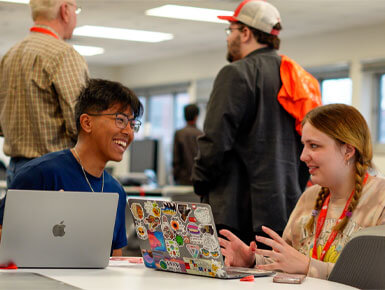
The duo took first place for their project, “American Sign Language Music Interpreter,” which stood out for both its clarity and impact. The app they pitched, Signify, uses beat detection and lyrics to generate ASL visuals—such as an interpreter—and color cues that reflect a song’s mood and tone so that users can experience music visually instead of auditorily.
Together, Kathol and Maharjan delivered a project with a functional demo, a polished pitch and a clear sense of purpose, while addressing an accessibility gap.
Now, the first-ever winners of USD’s hackathon are sharing their experience.
You had never met before the hackathon; how did you team up, and what made the partnership work so quickly?
Kathol: We were paired together randomly for the hackathon. I had no previous coding experience, so I was very lucky to be paired with Aries, who is very knowledgeable about coding and AI. The partnership worked out so well because we combined our strengths and we had fun with it.
Maharjan: We were randomly paired by the organizers. What made it work so quickly was how free we felt to bounce ideas off of each other. As a result, we came up with an idea seamlessly and had fun while doing so.
With little to no coding experience, what inspired you to enter the hackathon?
Kathol: I saw on the hackathon page that no coding experience was needed, and I thought I would try something out of my comfort zone.
Maharjan: I had a little coding experience, but with the capabilities of LLMs—and the emphasis placed more on software architecture, having taste and making crucial design decisions—I felt compelled to actually build something, or at least try to do so.
What was the atmosphere like at the first-ever USD hackathon?
Kathol: The atmosphere was very supportive, especially since the hackathon leaders and mentors were always present. During working hours, it was quiet because everyone was working hard.
Maharjan: I loved the atmosphere. It was very welcoming, and it felt like all the mentors were there to usher us toward a creative and functional direction.
Why did you choose to create an American Sign Language music interpreter specifically?
Kathol: We had a different idea first—a scheduling app—but we wanted to do something more interesting. Ariestotle came up with the ASL translating idea, and we decided to add more elements to make it stand out, such as the colorful visuals.
Maharjan: While we were bouncing ideas off one another, we recalled a viral video of an ASL interpreter artistically interpreting a Rihanna song. We got excited and discussed how impactful it would be if any deaf or hard-of-hearing person could boot up whatever song they wanted and experience it through an ASL interpretation. Moreover, music is such an integral part of who we are, and I have a deep appreciation for it. We wanted to try and bring that experience to more people.
Before the hackathon, had either of you been involved in tech, accessibility work, music or sign language in any way?
Kathol: Before the hackathon, I had some experience using ASL for my job at Southeast South Dakota Activity Center, as well as some accessibility training. I have never done tech, aside from some amateur graphic design for fun. For music, I have played instruments for many years and currently participate in the Social Justice Choir here in Vermillion.
Maharjan: No, not at all. I have always been interested in tech, but I never had the opportunity to work on it firsthand before this.
What was the biggest technical challenge you faced while building the demo?
Kathol: The hardest part was the virtual interpreter. It had to be a 'skeleton' for the demo because the technology for human-like virtual interpreters still needs improvement, and it couldn't do all of the complex ASL signs.
Maharjan: Most of the challenge was making decisions about which features to include and which to omit. On the technical side, the primary difficulty was extracting data from online videos of people signing and converting that data into meaningful animations.
How did you stay focused on delivering a project with a clear meaning and use? How did the support, resources or USD mentorship available help develop your project?
Kathol: We stayed focused by spending a lot of time in the breakout rooms and collaborating. The hackathon also provided mentors during the weekend, which was so helpful for us. They approached us to see if we needed assistance, which made the process a lot less daunting. I felt like we could always ask questions and seek advice.
Maharjan: We focused our discussions on the elements that would directly help the user rather than just adding features for the sake of it. We talked a lot about eliminating fluff and being deliberate with what we put into the app. When we asked for feedback from the mentors or others, I truly felt it all came from a place of wanting to help. This support significantly shaped how we made our design decisions.
Winning first place at USD’s first-ever hackathon is a huge achievement. What was your reaction when your team was announced as the winner?
Kathol: I honestly didn’t know it was the first-ever hackathon; everyone seemed to know what they were doing! But finding out afterwards was very exciting and I am so happy I got to be part of that experience. I was very proud of our team when the winners were announced, and very surprised! All of the teams had such impressive presentations; it was so fun getting to see everyone's hard work.
Maharjan: The idea of working on something to completion was gratifying in itself, and the win allowed me to truly be present and take it all in even more.
What does this achievement mean to you personally as students at USD?
Kathol: As a student at USD, this experience was meaningful to me because it reinforced the value of a liberal arts education. It was such a special experience collaborating with and meeting people with different academic backgrounds, unique experiences and skills. As a psychology student, it was encouraging to see how skills like communication, creativity and understanding human behavior can contribute, in addition to technical and business expertise. I felt like the hackathon showed me a glimpse of what it’s like to collaborate with others in a professional setting. It also showed me that, in addition to specialized skills, passion and dedication are important parts of success.
Maharjan: I was happy the hackathon took place and that I was able to participate. I have many friends at USD, and I often wish for more events like this. Seeing it finally materialize was a joyous experience.
What advice would you give to another USD student who would like to participate in next year’s hackathon?
Kathol: I would tell them to go for it! The organizers make sure to pair people with different skillsets, so there will be someone on your team who has coding experience if you don't. I also joined, not knowing anyone who was participating, which was a little intimidating at first. Everyone was welcoming and open to meeting new people. It is a great experience to learn new skills, challenge yourself and meet other students whom you normally wouldn't have the opportunity to meet.
Maharjan: I would say, with sincerity, that typing syntax is no longer the primary barrier to entry for building software. Getting a project off the ground has become highly accessible. Transforming an idea into a working prototype is now very much within reach, and they should definitely give it a go.
You May Also Like

Avera, SDSU and USD Sanford School of Medicine Establish Statewide NIH Research Partnership
The National Institutes of Health awarded $11,090,204 over five years to establish the South Dakota Center for Advancing Clinical and Translational Research (SD-ACT), a statewide partnership among Avera Research Institute, South Dakota State University and the University of South Dakota Sanford School of Medicine.

USD Philosopher Joseph Tinguely Awarded John Templeton Foundation Grant
Joseph Tinguely, Ph.D., was recently awarded a grant from the John Templeton Foundation in the amount of $435,790. This grant will support him as he organizes interdisciplinary collaborators with the aim of producing a conference, an edited manuscript and a series of public-facing media.

Educators Rising Day Welcomes Future Educators, Inspires Next Generation
The University of South Dakota welcomed approximately 150 high school students from 12 schools across South Dakota and Nebraska on Sept. 23 for Educators Rising Day, an event designed to introduce students to careers in education and help them explore their future as teachers, leaders and advocates.
